

Surgical Loupes · Clinical applications
Which magnification to choose for surgical loupes based on depth of field
A guide to matching magnification, field of view and depth of field in surgical loupes, with criteria by specialty, posture and working distance.
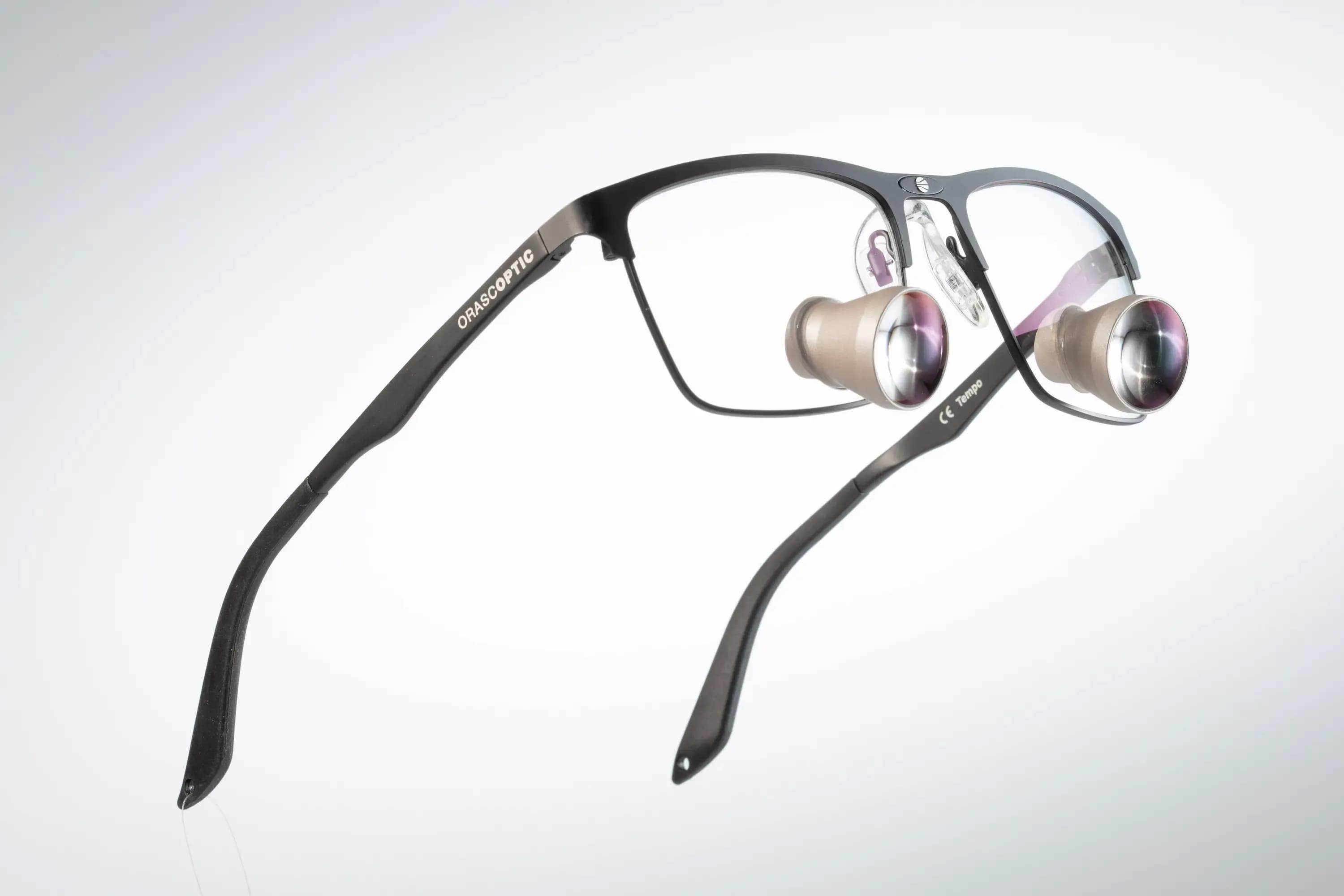
Which magnification to choose for surgical loupes depends on the balance between detail, field of view and depth of field. The higher the magnification, the greater the emphasis tends to be on visual precision, while the sharp area and the observed field may require more control of posture, working distance and lighting.
Which magnification to choose for surgical loupes: three inseparable variables
Magnification should not be approached as an isolated figure. In clinical practice, the professional works within a system made up of the loupes, working distance, posture, lighting and the type of procedure. Changing one of these variables alters the experience of the others.
In general terms, lower magnification provides a wider view of the operative field and a more comfortable transition between nearby areas. Higher magnification makes it possible to observe smaller details, but demands greater visual stability and a more precise setup. Between these two extremes lies the depth of field, which indicates the margin within which the image remains sharp without constantly readjusting position.
That is why, when reviewing a range of Orascoptic surgical loupes, it is worth assessing not only the available magnifications, but also how they integrate with the lens type, frame, declination angle and the user’s ergonomics.
Detail, field of view and depth of field
Magnification affects three aspects that must be balanced:
- Visible detail: ability to distinguish fine structures in the working area.
- Field of view: breadth of the area seen without moving the head.
- Depth of field: distance range over which the image remains sharp.
None of these factors is absolute. A procedure with small areas and little variation in height can tolerate more demanding magnifications. By contrast, an intervention with frequent movements, changes of plane or the need to see broader anatomical references may benefit from a more generous visual field.
How depth of field influences magnification selection
Depth of field is especially relevant when the professional does not always work on a single plane. In surgery, dentistry, microsurgery or outpatient procedures, the actual distance to the tissue may vary depending on patient position, field inclination, instrumentation or anatomical access.
A wider depth of field offers more margin to maintain sharpness even when there are small changes in position. This can be useful in dynamic procedures or when alternating between a general view and a detailed area. A narrower depth of field, on the other hand, requires greater precision in maintaining working distance.
This variable is also related to visual fatigue. If the professional works outside the optimal range, they may try to compensate by leaning closer, raising the shoulders or flexing the neck. The issue is not only seeing larger or smaller, but maintaining a sustainable posture throughout the clinical act.
That is why it is advisable to first review the working distance in surgical loupes and then assess magnification. Working distance sets the point from which the optical configuration is designed.
Use scenarios: from broad vision to fine detail
The question of which magnification to choose for surgical loupes changes according to the type of task. There is no universal figure for an entire specialty, because within the same discipline there may be examination, preparation, suturing, dissection, restoration, implantology or work in deep cavities.
The following table summarises common scenarios without turning them into fixed recommendations:
| Clinical scenario | Usual visual priority | Depth of field consideration |
|---|---|---|
| Examination, hygiene, treatment or general review | Wide field and spatial orientation | A comfortable margin for moving between areas is usually desirable |
| Restorative procedures or routine suturing | Balance between detail and peripheral vision | It is advisable to maintain sharpness without constant readjustments |
| Endodontics, microsurgery or deep areas | Fine detail and control of the critical area | Requires a very accurately measured working distance |
| Surgery with changes of plane | Alternation between broad field and detail | Depth of field helps maintain sharpness during movement |
| Prolonged work in a fixed area | Precision and stable posture | Ergonomics matter as much as the chosen magnification |
The table should be understood as a tool to prepare the trial, not as a prescription. Two professionals in the same specialty may need different configurations if their height, posture, technique and working distance differ.
Magnifications by specialty: guiding criteria without absolutes
General dentistry, hygiene and non-surgical periodontics
In tasks where the professional alternates between examination, instrumentation and viewing full arches, a wide field of view is often valued. Depth of field makes it easier to keep the image sharp during small movements around the patient.
In this context, a moderate magnification may be sufficient to gain detail without losing too much peripheral reference. It is also worth considering the weight of the system and the integration with frontal illumination, since the oral cavity can present deep shadows even with adequate ambient light.
Endodontics and restorative dentistry
Endodontics and certain restorative procedures require greater attention to fine details. However, magnification must still be compatible with working posture and actual usage time. An excessively narrow field may require repositioning the head more often.
Here, depth of field becomes important because the professional may alternate between access view, internal walls, instruments and external references. The chosen magnification should allow work within a clearly defined sharp range that matches the measured working distance.
Oral surgery, implantology and surgical periodontics
In oral surgery and implantology, moments of anatomical orientation are combined with phases requiring detail. The choice of magnification depends on whether the procedure requires a broad view of the field, precise observation of tissues or alternation between both.
A configuration that provides sufficient depth of field can help preserve sharpness when the inclination of the surgical field changes. It is also important to consider the use of headlight, because magnification increases the need for coaxial and stable illumination in the observed area.
Plastic surgery, vascular surgery and microsurgery
In specialties involving fine work on tissues, vessels, sutures or reduced planes, visual detail carries considerable weight. Even so, selecting a high magnification without reviewing ergonomics can lead to forced posture or limit awareness of the surgical surroundings.
In these cases, the trial should include real movements: approaching the field, handling instruments, changes of plane and sustained observation times. Depth of field should be assessed during that simulation, not only while looking at a fixed object.
ENT, dermatology and outpatient procedures
Some consultations and procedures combine examination, minor intervention and frequent changes in position. In these scenarios, it may be useful to prioritise a versatile configuration with good tolerance to small distance variations.
If the professional works standing, sitting or alternating between both positions, the working distance should be measured in each representative situation. Magnification selection should follow that postural reality.
Orascoptic loupe families and magnification types
The Orascoptic range allows loupes to be configured with different optical approaches. To choose with sound criteria, it is useful to understand some common industry terms.
Galilean loupes are usually associated with lightweight configurations and moderate magnifications. They can suit professionals seeking a balance between field of view, adaptation comfort and frequent use throughout the day.
Prismatic loupes are intended for higher magnifications and greater detail observation. Their configuration requires particular attention to adjustment, working distance and postural stability.
The TTL (through-the-lens) design integrates the telescope into the lens with a customised distance, angle and position configuration. The flip-up system, by contrast, allows the telescopes to be flipped up, although it usually requires consideration of weight, centre of gravity and usage habits.
Within Orascoptic, models such as EyeZoom, EyeZoom Max, EyeZoom Mini, ErgoZoom, HDL or OmniOptic respond to different needs in magnification, ergonomics and working style. The choice should not be based on the family alone, but on a trial tailored to the specialty and clinical environment.
For a broader overview of the topic, you can consult the previous guide on which magnification to choose for surgical loupes, which introduces the basic criteria. This guide goes deeper into how depth of field changes the decision depending on the use case.
Ergonomics, working distance and frontal lighting
Magnification selection must go hand in hand with ergonomics. A magnification that looks suitable on paper may be impractical if it forces you to flex the neck, lean toward the patient or raise the shoulders to find sharpness.
Working distance is measured from the professional’s eyes to the clinical area in a natural posture. If it is calculated in an artificial posture, the loupes may be configured for a position that will not be maintained during real work.
The declination angle also matters. A well-adapted angle allows you to look at the operative field without excessively tilting the head. At higher magnifications, this variable becomes more sensitive, because the margin for visual compensation may be smaller.
Frontal lighting completes the system. As magnification increases, light input and shadow perception become more important. A front light for loupes can improve visibility of the field by aligning light with the line of sight, especially in cavities or deep planes.
Checklist for preparing a surgical loupes trial
Before configuring loupes, it is worth gathering information about real-world use. This checklist helps make the trial more representative:
- Specialty and main procedures. Identify whether examination, surgery, suturing, endodontics, restoration, microsurgery or combined tasks are predominant.
- Usual posture. Confirm whether work is performed sitting, standing or alternating between positions.
- Actual working distance. Measure it in a natural, not forced, posture.
- Duration of use. Assess whether the loupes will be used for specific procedures or for most of the working day.
- Need for a wide field. Determine whether the procedure requires peripheral references or a very localised area.
- Need for fine detail. Review the size of the structures observed and the level of visual precision required.
- Changes of plane. Consider whether the work is done on a stable surface or with frequent depth variations.
- Available lighting. Assess whether the environment requires headlight support.
- Frame and fit. Check stability, nose comfort, perceived weight and compatibility with the workflow.
- Progressive adaptation. Allow for a familiarisation period, especially if changing magnification or optical type.
This process makes it possible to compare options in an orderly way. The trial should not be limited to reading text or looking at a static image: it should reproduce the real gestures of the specialty.
Frequently asked questions
Which magnification should I choose for surgical loupes if I want more depth of field?
If the priority is to maintain sharpness with small distance variations, it is advisable to consider moderate magnifications and a well-measured working distance. Higher magnifications can provide more detail, but they usually require greater postural stability and a more precise optical setup.
Is depth of field more important than field of view?
They are not interchangeable variables. Field of view indicates how much is seen at once; depth of field, the margin of sharpness in distance. In dynamic procedures, both influence visual comfort and the need to move the head, neck or torso.
What is the difference between Galilean and prismatic loupes?
Galilean loupes are usually used for moderate magnifications and lightweight configurations. Prismatic loupes are used when a higher level of detail is needed. The choice depends on the specialty, working distance, tolerance for the visual field and the professional’s ergonomics.
When is it advisable to add frontal lighting to loupes?
Frontal lighting is especially useful when the field has shadows, cavities or deep planes. When working with magnification, a light aligned with the line of sight can make observation more homogeneous, provided that the weight and fit are compatible with the intended use.
Can the same professional need more than one magnification?
Yes, that can happen when combining very different procedures. Some tasks prioritise a wide field and others require fine detail. In those cases, the advice should consider the volume of each procedure, ergonomics and the available configuration options.
Next step: configure magnification with a real trial
Choosing magnification in surgical loupes requires relating detail, field of view, depth of field, posture and lighting. The magnification figure only becomes meaningful when tested at the working distance and with the gestures specific to each specialty.
To review Orascoptic options and prepare a customised configuration, request technical advice on surgical loupes.