

Surgical Loupes
Variable-Magnification Surgical Loupes: When They Pay Off
A guide to understanding what variable-magnification surgical loupes are, when they provide versatility, and which criteria to review before choosing them.
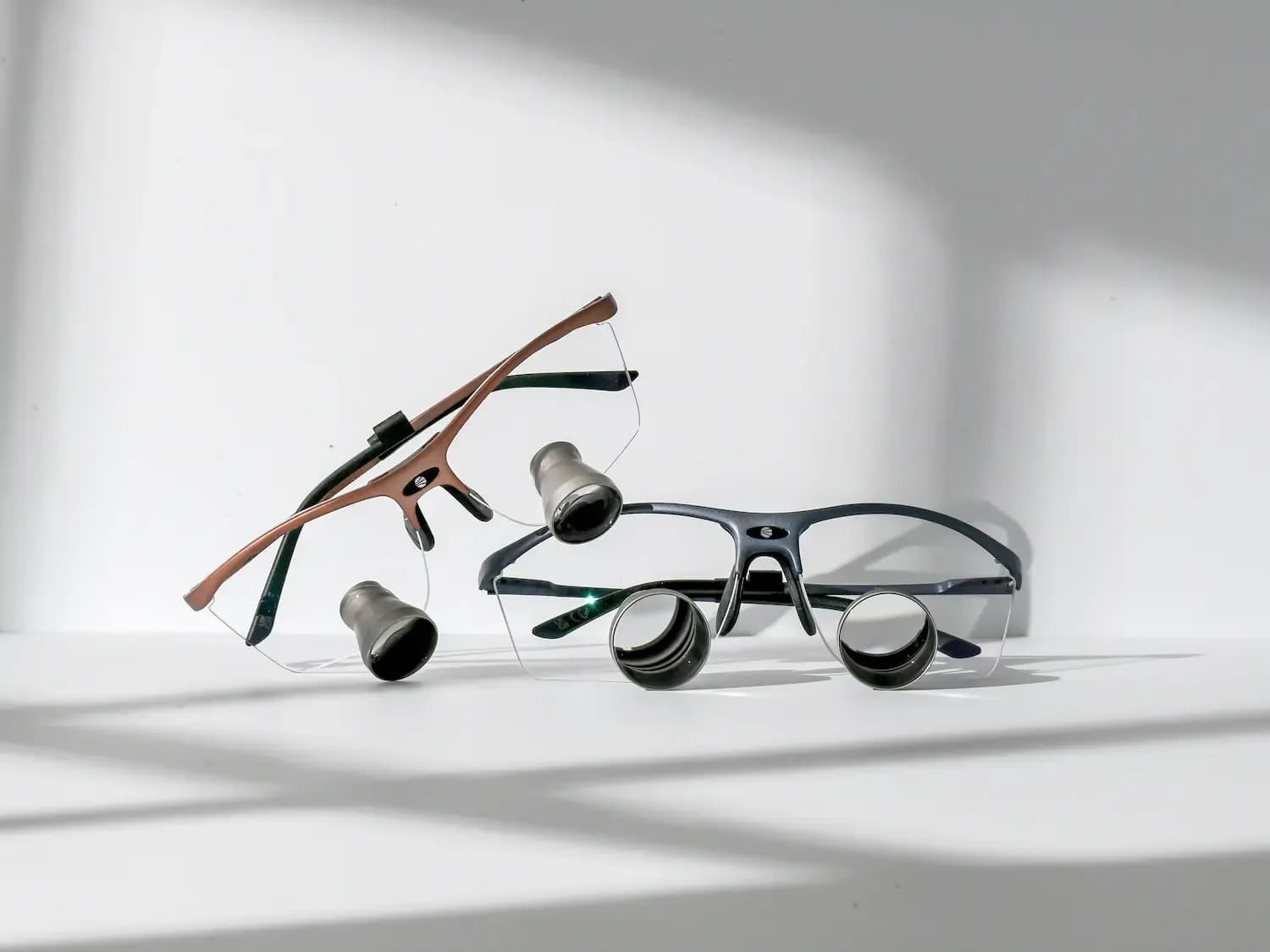
Variable-magnification surgical loupes make it possible to switch between different levels of magnification within a single optical solution. They are useful when the professional changes procedure, working distance, or level of detail during the day, and wants to assess greater versatility than that offered by a fixed configuration.
What adjustable surgical loupes, or variable-magnification loupes, are
In the professional setting, adjustable surgical loupes are understood as surgical loupes that allow the user to modify magnification without changing the entire system. Instead of always working with fixed magnification, the user can adapt the level of detail to the clinical or surgical task.
This concept is especially relevant in disciplines where not all interventions require the same visual field or the same level of observational precision. A lower magnification can facilitate overall orientation, while a higher magnification helps inspect smaller structures or areas with complex access.
The key is not just “seeing bigger.” A surgical loupe must maintain a balance between magnification, field of view, depth of focus, working distance, and ergonomics. When variability is introduced, that balance must be reassessed at each magnification setting.
Within the range of surgical loupes, EyeZoom is an example of an Orascoptic solution aimed at professionals seeking variable magnification. Its appeal lies in offering several magnification levels within the same product family, without presenting itself as a universal substitute for all fixed loupes.
When variable magnification makes sense
Variable magnification makes sense when the professional alternates between tasks with different visual needs. Not all specialties require this flexibility, but it can be useful in clinics or operating rooms where the workflow changes frequently.
Common scenarios include:
- Procedures that begin with a broad view and move into a detailed phase.
- Professionals who combine diagnosis, treatment, and review in the same session.
- Specialties in which working distance may vary from one clinical act to another.
- Users who are still defining which magnification best suits their practice.
In these cases, variable-magnification surgical loupes can reduce the need to switch between several fixed-magnification loupes. Even so, it is worth assessing whether that flexibility will actually be used in daily practice.
If the professional always works with the same type of procedure, the same posture, and a very stable distance, a well-adjusted fixed configuration may still be an appropriate option. The decision does not depend on whether one technology is “better,” but on the specific way of working.
Variable magnification versus fixed magnification: practical criteria
The choice between variable magnification and fixed magnification should consider more than the number of available magnification levels. In a surgical loupe, every optical decision influences the user experience.
| Criterion | Variable magnification | Fixed magnification |
|---|---|---|
| Versatility | Allows magnification to be adapted to different tasks | Maintains a constant configuration |
| Adaptation | Requires learning when to change magnification | Is usually more straightforward at the start |
| Field of view | May vary depending on the selected magnification | Stable within the chosen configuration |
| Depth of focus | May change with magnification | Predictable in daily use |
| User profile | Professionals with varied procedures | Professionals with very well-defined visual routines |
The field of view is usually wider at lower magnifications and more limited at higher magnifications. This is not a defect, but a common consequence of magnifying optics. For that reason, the professional should assess whether they need to see a broad area, focus on a detail, or alternate between both situations.
Depth of focus also plays a role. Greater depth tolerance can make small changes in position easier without losing perceived sharpness. As magnification increases, that tolerance may become more demanding, so posture and working distance become more important.
EyeZoom as an example of adjustable surgical loupes
EyeZoom makes it possible to bring the concept of adjustable surgical loupes into a concrete product within the Orascoptic range. It is aimed at professionals who want variable magnification without giving up the professional surgical loupe format.
Its value is especially clear in contexts where the user may need a more general view at certain moments and more detailed observation at others. For example, in procedures that combine exploration, preparation, and fine review of specific areas.
The choice of EyeZoom should be made within a full assessment: magnification, working distance, frame, lighting, perceived weight, and postural habits. It is also advisable to review whether the professional works seated, standing, or alternating between both positions.
When comparing options, it is useful not to isolate the loupe from its accessories. Pairing it with a suitable headlight can affect the perception of the field and contrast, especially in cavities or areas with limited ambient light.
Specialty, working distance, and ergonomics
The specialty shapes the decision. In dentistry, microsurgery, plastic surgery, ENT, surgical dermatology, and other precision areas, visual needs can vary greatly from one procedure to another. For that reason, variable magnification should be assessed from real-world use, not from a generic table.
Working distance is one of the critical points. A loupe adjusted for an incorrect distance can force the cervical or lumbar posture. The goal is for magnification to support a stable position, not to force the professional to move closer than recommended in order to see detail.
The adaptation curve also matters. Changing magnification during work requires becoming familiar with the visible field, depth, and spatial perception of each position. Adaptation is usually easier when the professional receives technical guidance and tests the configuration in conditions close to their practice.
At this point, it may also be useful to review the differences between TTL and flip-up systems. The article on TTL vs flip-up loupes by specialty helps place the optical design choice before deciding whether variable magnification is the right option.
Checklist before choosing adjustable surgical loupes
Before requesting a recommendation, it is worth organizing your needs. A simple checklist helps prevent choosing only based on the maximum available magnification.
- Which procedures take up the most time in the day?
- Is there a need to alternate between general vision and fine detail?
- Is the working distance stable or does it change between tasks?
- Does the professional already use loupes, or would this be the first adaptation?
- Which posture is maintained the longest: seated, standing, or mixed?
- Will the user work with integrated or independent headlight illumination?
- Is the priority versatility, a wide field, lightness, or visual stability?
The answers help distinguish between a well-selected fixed loupe and variable-magnification surgical loupes. They also make it easier to guide the trial, the frame selection, and the distance adjustment.
If in doubt, the best approach is to compare options with a technician. Optimedic can guide the choice between fixed and variable magnification, review the Orascoptic range, and assess whether EyeZoom fits the usage profile. To do so, you can request information about surgical loupes.
Frequently asked questions
What are variable-magnification surgical loupes?
They are professional loupes that allow switching between different magnification levels within a single optical solution. They are used when the professional needs to adapt vision to different tasks, alternating between a broader view and a more detailed one depending on the procedure.
Do adjustable surgical loupes replace fixed-magnification loupes?
Not necessarily. A fixed loupe may be appropriate when the professional works with very consistent procedures, working distance, and posture. Adjustable surgical loupes make more sense when there is real variability in practice and the option to change magnification is actually used.
What should be assessed besides magnification?
It is advisable to review field of view, depth of focus, working distance, perceived weight, frame, lighting, and adaptation curve. Magnification is only part of the system. A comfortable and stable configuration depends on how all those elements fit into daily practice.
Is EyeZoom a variable-magnification option?
Yes, EyeZoom is an Orascoptic option associated with the concept of variable magnification. Its suitability should be assessed according to the specialty, habitual procedures, and working distance. It is also advisable to review the frame and lighting that will accompany the loupe.
Next step to evaluate an adjustable loupe
Variable-magnification surgical loupes are especially relevant when practice requires alternating levels of detail. The decision should be based on real procedures, posture, and working distance. To compare options, you can review the range of Orascoptic surgical loupes or speak with an Optimedic technician.