
Surgical Loupes · Ergonomics and health
Surgical loupes for periodontics: magnification, field of view and ergonomics
Guide to choosing surgical loupes for periodontics by balancing magnification, field of view, working distance, frame and headlight illumination.
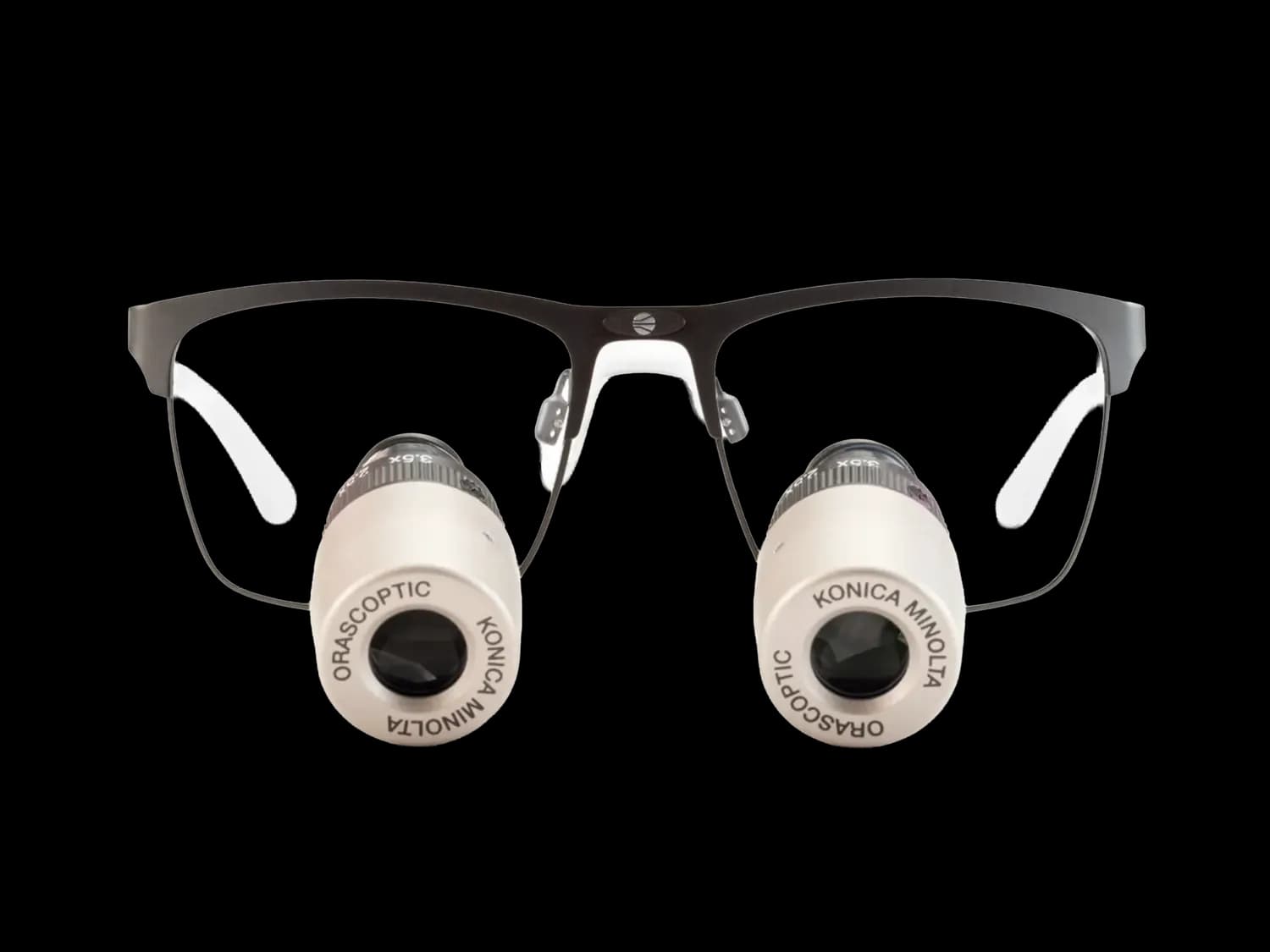
Surgical loupes for periodontics must balance magnification, field of view, depth of focus and ergonomics. The choice does not depend only on seeing more detail, but on maintaining control of the anatomical context, working at a comfortable distance and sustaining a stable posture during lengthy procedures.
Surgical loupes for periodontics: what the specialty requires
Periodontics combines procedures that require visual precision with a constant reading of the anatomical environment. In a single session, direct access areas, posterior regions, soft tissues, margins, manual instrumentation and field control may alternate. For that reason, magnification should help identify details without isolating the professional from the whole.
In practical terms, surgical loupes for periodontics are not chosen solely by the number of magnifications. The width of the field of view, the depth of focus, the working distance, the weight of the system and compatibility with the professional’s usual posture also matter.
An appropriate setup should allow a smooth transition between detail and orientation. If the field is too narrow, the professional may need more head movements to relocate references. If the magnification is insufficient, certain details may require greater visual effort. The balance point depends on the type of procedure, experience with magnification and working style.
To review available magnification options, you can consult the Optimedic surgical loupes section, where configurations tailored to different clinical profiles are grouped.
Magnification and field of view: how to find the balance
Magnification determines the level of detail perceived, but it also affects the field of view. In general, the higher the magnification, the smaller the area visible in a single glance. This relationship is key in periodontics, where you need to observe specific structures without losing references from the working area.
A reasoned choice starts with three questions:
- Does the procedure require fine detail continuously or only in specific phases?
- Does the professional need to see a wide area to guide instrumentation?
- Does prior experience with loupes allow working with narrower fields without losing fluidity?
Choosing the highest available magnification is not always the best option. For many periodontal procedures, moderate magnification can provide a good view of detail with a sufficiently wide field. In other cases, especially when finer visualization is the priority, increasing magnification may be worthwhile, provided the professional adapts to the resulting field.
| Criterion | More moderate magnification | Higher magnification |
|---|---|---|
| Field of view | Wider | Narrower |
| Anatomical orientation | Easier | Requires greater adaptation |
| Perceived detail | Suitable for overview and routine fine work | Greater detail in specific areas |
| Adaptation curve | Usually more gradual | May require more training |
| Use in long sessions | Depends on posture, weight and working distance | Depends more on precise setup |
The decision should be made considering the whole system, not an isolated variable. Ideal magnification loses value if it forces you to bend your neck, move too close or constantly readjust your head to regain references.
To explore this in more depth, the guide on which magnification to choose for surgical loupes develops useful criteria for comparing options according to specialty and working habits.
Depth of focus and working distance in long sessions
Depth of focus is the range in which the image remains sharp without the need to continuously change body position. In periodontics, it can be especially relevant because the professional alternates micro-adjustments, changes in angulation and movements over irregular anatomical surfaces.
An adequate depth of focus makes it possible to maintain sharpness within a functional margin. This does not mean it removes the need to adjust position, but it helps reduce visual interruptions when there are small changes in plane.
Working distance is directly related to posture. If it is too short, it can encourage cervical flexion or trunk inclination. If it is too long for the user’s height, the patient position or the chair, it may require raising the shoulders or separating the arms excessively. The distance should match the real way of working, not an ideal posture that is hard to maintain.
Before configuring the loupes, it is worth observing:
- The professional’s usual seated height.
- The patient’s position during frequent periodontal procedures.
- The natural inclination of the head and neck.
- The distance between the eyes and the operating field.
- The need to alternate magnified vision and direct vision.
These elements help define a more coherent setup. In professionals who carry out long sessions, visual comfort does not depend only on optics. It is also related to the frame, the nasal fit, facial stability and weight distribution.
Lightweight setup and posture: when it can help
A lightweight setup can be useful when the professional needs to maintain a stable posture for a long time or alternate procedures throughout the day. Weight should not be assessed only in grams, but in how it is distributed across the nose, ears and forehead.
In periodontics, where movements can be repetitive and highly concentrated, a stable frame avoids frequent readjustments. It also helps keep the visual axis aligned with the working area. If the loupes shift, even slightly, the professional may compensate with small neck or back movements.
Frame selection is part of the optical configuration. It is not a secondary accessory. It should be reviewed together with magnification, interpupillary distance, working distance and lens type.
A frame can be assessed by:
- Stability during head movements.
- Compatibility with facial anatomy.
- Comfortable nasal fit.
- Balanced weight distribution.
- Ability to be combined with headlight illumination.
- Sense of security during long sessions.
The surgical loupes frames options allow the setup to be adapted to the professional’s profile. In addition, the guide on how to choose a frame for surgical loupes explains what aspects to review before deciding.
TTL or flip-up: impact on daily use
TTL (through-the-lens) loupes integrate the telescopes into the lens according to a customized setup. They are usually associated with a more defined working position, because the declination angle and distance are adjusted for each user.
Flip-up loupes allow the optical system to be lifted when magnification is not needed. They can be practical if the professional frequently alternates between magnified vision and direct vision. In return, they often require attention to adjustment and system stability.
The decision should not be based on a generic preference, but on the real workflow. In periodontics, if you work for long periods in the same area and with a stable posture, a TTL setup may make sense. If you alternate observation, communication and instrumentation tasks, a flip-up system can provide flexibility.
Headlight illumination: when it is worth including
Headlight illumination can add value when access is limited, the oral cavity creates shadows or greater contrast is needed in specific areas. In periodontics, the field may be affected by the patient’s position, anatomy, instrumentation and the operatory light direction itself.
The question is not whether a headlight is always necessary, but under which conditions it helps you work more consistently. A coaxial light aligned with the line of sight can reduce shadows caused by the head or hands. It can also facilitate the reading of reliefs and margins when ambient light does not fall appropriately.
It is worth considering headlight illumination when:
- You frequently work in posterior sectors.
- There are areas with narrow visual access.
- The unit light does not match the viewing angle well.
- Greater contrast is needed in the observed area.
- The chosen magnification requires more precise illumination.
However, adding illumination also changes the system. It can alter front weight, cable or battery management and the sense of balance on the frame. For that reason, it should be tested as part of the complete setup, not as an isolated add-on.
In the Optimedic Loupes solutions section, you can review the loupes, frames and lighting ecosystem to configure the system according to clinical use.
Criteria before customising surgical loupes for periodontics
Before ordering a custom setup, it is worth gathering information about real-world use. Customisation should respond to how the professional works, not only to a standard specialty recommendation.
1. Most frequent procedures
Not all periodontal schedules have the same profile. Some professionals perform sessions focused on periodontal maintenance, while others combine periodontal surgery, implantology, microsurgery or regenerative procedures. Each context may require a different relationship between detail and field of view.
2. Level of experience with magnification
Someone starting with loupes may adapt better to moderate magnifications and wider fields. Someone already working with magnification may value more demanding visual configurations if their technique and posture allow it.
3. Real working distance
Measurement should be made by reproducing the usual posture. If it is measured in a forced position, the loupes may be configured for ergonomics that cannot be maintained in practice.
4. Declination angle
The declination angle influences cervical position. A suitable adjustment allows you to look at the operating field without excessive neck flexion. It should be defined together with the working distance and the patient’s height.
5. Frame and stability
The frame must keep the optics aligned. If there is slippage, uncomfortable pressure or lack of stability, the professional may end up compensating with postural movements.
6. Need for headlight illumination
Light should be assessed according to access, shadows, contrast and procedure length. The comfort of the complete setup should also be checked.
7. Compatibility with other elements
Mask, eye protection, cap, face shield or lighting systems can modify the feeling of fit. The trial should approximate the real working environment.
Decision checklist
Before choosing surgical loupes for periodontics, it may be useful to review this list:
- The magnification allows you to see the necessary detail without losing anatomical orientation.
- The field of view is sufficient for the usual procedure type.
- The depth of focus supports the most frequent plane changes.
- The working distance supports a sustainable posture.
- The frame remains stable without excessive pressure.
- The weight of the system is suitable for long sessions.
- Headlight illumination adds value in the usual access areas.
- The setup has been tested in a posture similar to the real one.
- The professional understands the adaptation curve required.
- Technical guidance is available to fine-tune the choice.
This review reduces decisions based only on magnification or aesthetics. In clinical magnification, quality of use appears when optics, frame, lighting and posture work as a system.
Frequently asked questions
What magnification should you choose in surgical loupes for periodontics?
It depends on the balance between detail and field of view. Moderate magnification may be appropriate when broad anatomical orientation is needed, while higher magnification may be preferable in procedures with greater detail demands. The choice should consider prior experience, working distance, posture and the type of procedure usually performed.
Should surgical loupes for periodontics include headlight illumination?
It is not always essential, but it can be useful when there are shadows, posterior accesses or a need for greater contrast. Headlight illumination should be assessed together with weight, frame and session length, because it changes the balance of the system on the face.
How does working distance affect comfort?
Working distance affects cervical posture, trunk position and the relationship with the patient. If it does not match the real way of working, the professional may compensate by moving closer, tilting the neck or raising the shoulders. That is why it should be measured in a representative clinical position.
Is a lightweight setup better for periodontics?
A lightweight setup can help when performing long sessions or when trying to reduce readjustments during work. Even so, weight is not the only criterion. Frame stability, load distribution and alignment of the optics with the operating field are also important.
Next step for configuring periodontic loupes
Choosing loupes for periodontics means adjusting magnification, field of view, working distance, frame and illumination to real clinical use. For a custom setup, it is advisable to review posture and usual procedures with technical guidance.
If you would like to assess specific options, you can request information about surgical loupes and prepare a setup adapted to your way of working.