

Surgical Loupes · Ergonomics and health
Surgical Loupes for ENT: Selection Guide
A guide to choosing surgical loupes for ENT based on field of view, depth of field, magnification, posture, and front illumination.
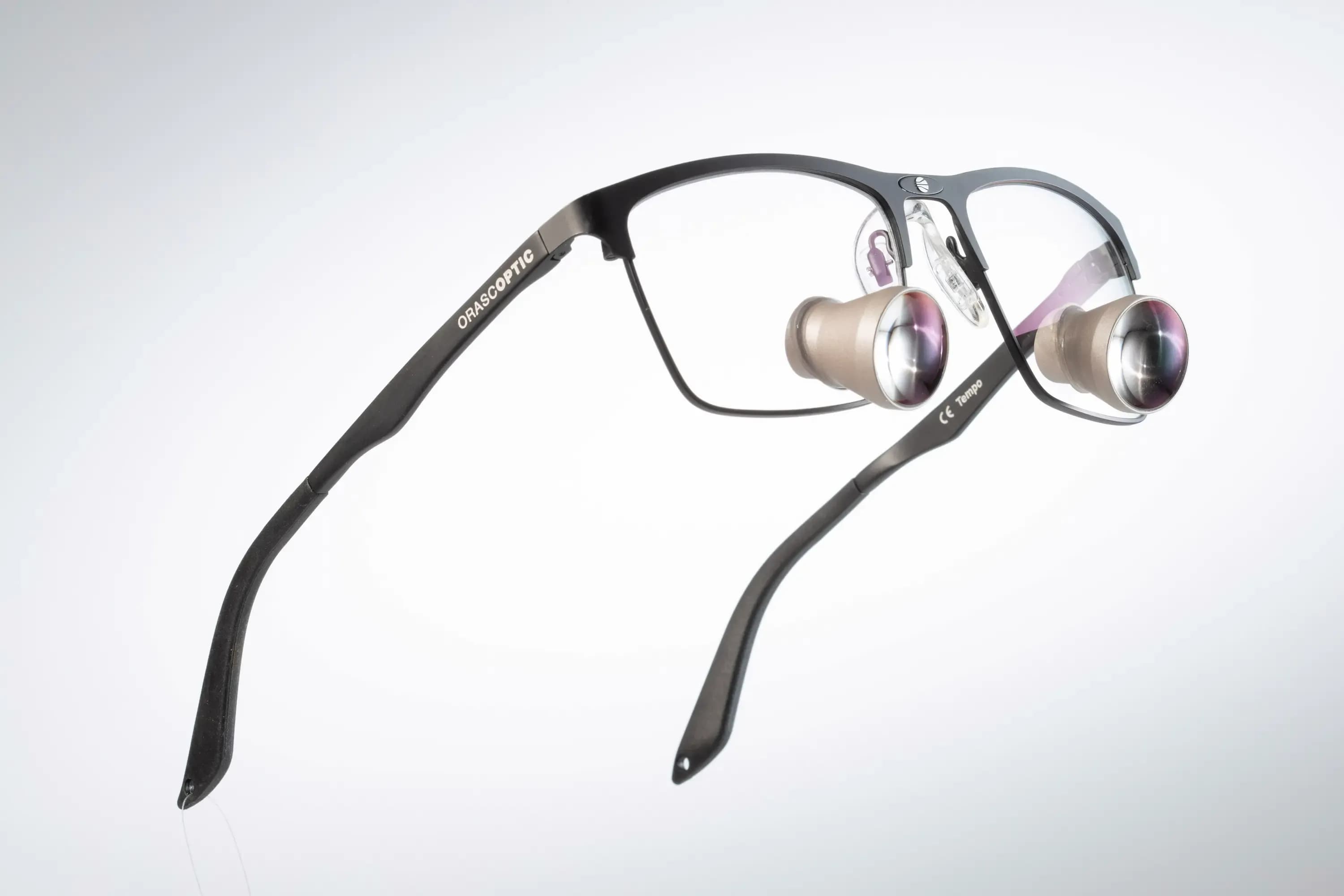
The surgical loupes for ENT should be selected by balancing magnification, field of view, depth of field, working distance, and posture. In a specialty with narrow access and frequent changes in plane, a comfortable and stable configuration is usually more useful than excessive magnification that is difficult to maintain.
How to choose surgical loupes for ENT
ENT combines procedures with very different visual needs. In a single day, examinations, minor surgery, work on the nasal cavity, the outer ear, the larynx, or structures with limited access may alternate. That is why the choice of surgical loupes should not be based only on “seeing bigger,” but on maintaining a useful view throughout the clinical gesture.
In this context, three variables matter especially: field of view, depth of field, and posture. Magnification determines how much the observed area is enlarged, but it also conditions the breadth of the field and tolerance to small changes in distance. The higher the magnification, the smaller the field usually is and the more demanding the depth of field becomes.
The decision should start from the type of procedure, the level of detail required, and the professional’s usual working distance. It is also worth considering whether work is done standing or seated, whether planes are frequently alternated, and whether illumination of the field depends on external sources or a coaxial illuminator.
Field of view and depth of field: priorities in ENT
In ENT, the field of view makes it possible to keep enough anatomical references around the point of interest. This is important when access is narrow, the instrument occupies part of the visual space, or the professional needs to orient themselves with small head movements.
Depth of field, for its part, defines the margin of distance in which the image remains sharp without readjusting posture. When the working plane changes frequently, a depth of field that is too limited can force the torso, neck, or head to be repositioned more than desirable.
| Criterion | What it provides | Risk if poorly prioritized |
|---|---|---|
| Wide field of view | More anatomical context and better orientation | May not provide enough detail if magnification is low |
| Generous depth of field | Greater tolerance to changes in plane | May require adjusting magnification to a realistic need |
| High magnification | More detail over a specific area | Smaller field, more demanding adaptation, and more constrained posture |
| Appropriate working distance | More stable neck and back position | If not measured correctly, the loupe may induce cervical flexion |
For procedures with changes in depth, it is usually prudent to avoid a configuration that forces you to “chase” focus. The loupe should allow work within a comfortable range, not force the professional to adapt to it continuously.
When access is narrow
In narrow access situations, an excessively small field can make orientation difficult. Seeing a very small area in great detail can be useful at specific moments, but it is not always the most efficient approach throughout the procedure. The choice should take into account how much context the professional needs to work with technical safety and fluidity.
When there are frequent changes in plane
If the working plane varies, depth of field becomes more important. A very demanding configuration can make small movements by the patient, the instrument, or the professional themselves take the image out of the optimal point. In these cases, moderate magnifications and a well-defined working distance should be considered.
What magnification may be reasonable
There is no universal magnification for surgical loupes for ENT. The decision depends on the level of detail required, the working distance, and the professional’s tolerance for the available visual field. The goal is to find a balance: enough magnification to distinguish relevant structures, without unnecessarily sacrificing orientation and comfort.
As a practical criterion, lower magnifications usually make it easier to achieve a wider field of view and a faster adaptation. They may be suitable when magnified vision is needed with good spatial reference. Higher magnifications provide more detail, but they also require greater precision in distance, visual axis, and postural stability.
Before increasing magnification, it is worth asking three questions:
- Does the current level of detail truly limit the procedure?
- Is a stable posture maintained during the usual working time?
- Will the field of view still be sufficient for orientation?
If the answer to the third question is not clear, it may be preferable to review the full configuration rather than choosing more magnification automatically.
Magnification and working distance
Working distance is not an accessory parameter. It defines where the sharp plane is and conditions the position of the neck, shoulders, and back. A distance that is too short can encourage cervical flexion; a poorly measured distance can make the professional compensate with unsustainable postures.
On the Optimedic blog, there is a specific guide on working distance in surgical loupes that helps explain why this parameter should be measured before choosing a TTL or flip-up configuration.
Avoiding an overly aggressive magnification choice
A loupe with more magnification is not always a more suitable loupe. In ENT, excessively aggressive magnification can reduce the field of view, narrow the depth of field, and increase adaptation time. The practical result can be a less fluid experience, especially if the professional needs to alternate planes or maintain peripheral references.
This does not mean that high magnifications are not useful. It means they must correspond to a specific need and a compatible working technique. If the magnification forces you to get closer than desired, flex your neck, or constantly readjust your position, the configuration should be reconsidered.
A reasonable way to decide is to test the loupe in conditions similar to real work. It is not enough to look at a static object for a few seconds. It is advisable to simulate the usual distance, the patient’s position, the orientation of the field, and the movements that are repeated during the procedure.
Signs that magnification may be excessive
Some signs may indicate that the configuration is not the most suitable:
- Need to bring the head closer to recover sharpness.
- Frequent loss of orientation due to a reduced visual field.
- Feeling of cervical stiffness when trying to maintain the optical axis.
- Difficulty alternating between magnified vision and the working environment.
- Slow adaptation despite correct prescription and proper frame adjustment.
These signs are not always due to magnification. They may also be related to working distance, tilt, the frame, perceived weight, or illumination. That is why it is preferable to evaluate the whole system.
Posture: the role of ergonomic configuration
Posture depends not only on the professional’s will. It depends on how the loupe positions the working plane in relation to the eyes. A well-adjusted configuration should help maintain a stable position, with less need to flex the neck or move the head forward to see the field.
In demanding visual specialties, ergonomics becomes more relevant because visual concentration can lead the professional to tolerate uncomfortable positions for longer. The loupe should be chosen to support the usual working posture, not to impose a new position that is difficult to sustain.
TTL loupes, integrated into the lens, are usually customized according to the user’s parameters. Flip-up configurations allow the angle to be adjusted and the system to be lifted when not in use. Each option has practical advantages, and the choice should be made according to the intended use, the need for customization, and adaptation preferences.
For professionals who value a more upright working position, it may be useful to review when ergonomic surgical loupes are worth it, especially if there is already neck discomfort or a tendency to flex the neck during long procedures.
Front illumination in procedures with demanding visualization
Front illumination can be decisive when the field is narrow, deep, or partially shaded by the instrument. A front illuminator for loupes helps align the light with the visual axis, which is especially useful when ambient light does not reach the working area evenly.
In ENT, the light should not only be intense; it should be manageable. It is worth assessing the beam size, uniformity, added weight to the system, and the way it integrates with the frame. A powerful but uncomfortable illuminator can alter the user experience if it changes the balance of the loupe or adds tension in the nasal and temporal area.
It is also important to consider how the switch is operated, the wiring if present, battery life if the system runs on battery power, and practical compatibility with the professional’s routine. The aim is not to add an accessory by default, but to determine whether it improves visibility in procedures where external light is insufficient.
What to review before choosing the loupe, frame, and illuminator
A customized surgical loupes for ENT configuration should be reviewed as a system: optics, frame, prescription, illumination, and ergonomics. Choosing each element separately can lead to an unbalanced combination.
Before deciding, it is worth checking these points:
- Actual working distance: measured in the usual posture, not in an idealized position.
- Declination angle: sufficient to look at the field without excessive neck flexion.
- Magnification: adjusted to the required detail and the needed visual field.
- Field of view: adequate to maintain anatomical orientation.
- Depth of field: compatible with frequent changes in plane.
- Frame: stable, comfortable, and compatible with the professional’s facial anatomy.
- Prescription: integrated or adapted according to visual needs.
- Illuminator: aligned with the visual axis and balanced with the overall setup.
- Perceived weight: assessed during a sufficiently representative trial.
- Type of work: seated, standing, alternating, with microscope, or with other visualization systems.
The Optimedic Loupes range makes it possible to review loupes, frames, and illuminators as part of a complete configuration. In ENT procedures, this global view helps avoid decisions focused only on magnification.
TTL or flip-up: a practical decision
TTL loupes offer a more integrated and personalized configuration, with the telescopes placed in the lens according to the user’s parameters. Flip-up models allow the optical system to be lifted and certain elements to be adjusted with greater flexibility. The choice should not be seen as universally superior, but as a decision linked to the type of use.
If integration, stability, and a highly tailored working distance configuration are the priority, a TTL option may be suitable. If versatility, the ability to lift the telescopes, or shared adjustment in certain environments is the priority, a flip-up option may make sense.
Frequently asked questions
What magnification should be chosen in surgical loupes for ENT?
Magnification should be selected according to the level of detail required, the working distance, and the field of view the professional needs to preserve. In ENT, where there may be narrow access and changes in plane, the highest magnification is not always the best choice. It is preferable to balance detail, orientation, and postural comfort.
Why do field of view and depth of field matter in ENT?
The field of view helps maintain anatomical references around the working point. Depth of field allows sharpness to be preserved when the distance to the field changes slightly. In ENT, both factors are important because the professional may work in narrow areas and with planes that change during the procedure.
Do surgical loupes for ENT need front illumination?
It is not always essential, but it can be very useful when the field is deep, narrow, or shaded by the instrument. Front illumination aligns the light with the visual axis and can facilitate more even visualization. It should be assessed together with weight, the frame, and the usage routine.
How can you tell if a loupe is affecting posture?
A loupe may affect posture if it forces you to bring your head closer, flex your neck, or constantly readjust your position to maintain sharpness. This can also happen if the working distance is poorly measured or if the declination angle does not match the professional’s real posture.
Is it advisable to test the configuration before choosing it?
Yes. Testing allows magnification, field, depth of field, frame, and illumination to be assessed in conditions similar to real use. In a specialty such as ENT, where visualization can be demanding, testing the configuration helps identify whether the system is comfortable and consistent with the working technique.
Next step for a personalized configuration
Choosing loupes for ENT requires reviewing the full set: magnification, distance, field, depth, frame, and illumination. To assess a configuration adapted to each professional’s working style, you can request advice on surgical loupes and review the available options with a technician.