

Surgical Loupes · Ergonomics and health
Surgical loupes for endodontics: TTL or variable magnification
Technical comparison to help you choose surgical loupes for endodontics based on magnification, working distance, ergonomics, frontal lighting, and procedure type.
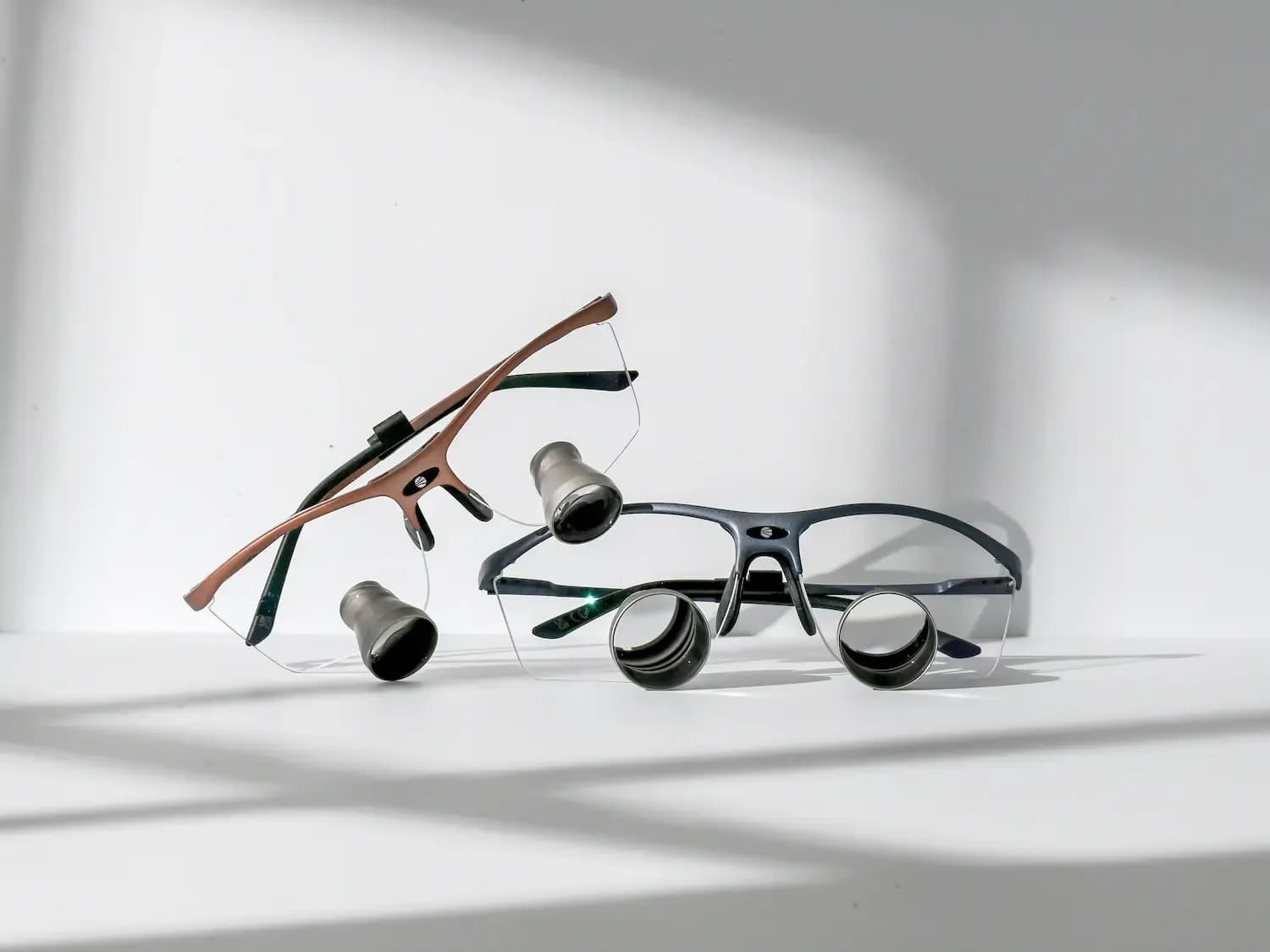
The surgical loupes for endodontics should be selected according to working distance, the magnification required, the field of view, and the professional’s posture. A TTL setup offers stability and a custom fit; a variable magnification system provides flexibility when the case requires alternating levels of detail.
Surgical loupes for endodontics: what changes between TTL and variable magnification
In endodontics, magnification is not assessed only by “seeing larger.” The goal is to maintain a clear and stable view during lengthy procedures, with a reasonable balance between detail, field of view, depth of focus, and ergonomics. That is why the choice between a TTL (through-the-lens) configuration and a variable magnification system does not depend on a single feature.
TTL loupes integrate the telescopes into the lens of the frame. They are configured with personalized parameters such as interpupillary distance, working distance, and declination angle. Their main practical advantage is stability: the professional works with a defined setup, without frequent adjustments during the procedure.
Variable magnification loupes, by contrast, allow you to alternate between different magnification levels within the same system. This option can be useful when the professional switches between tasks requiring general vision and fine detail, for example during initial assessment, access, canal location, or review of specific areas.
For a general overview of available models and configurations, you can consult the Optimedic Loupes section and the specific section on surgical loupes.
Practical differences between TTL and variable magnification
The comparison should be made from actual clinical use, not just from the technical sheet. In endodontics, the working field is small, lighting must be precise, and posture tends to be maintained for extended periods. These factors make small changes in angle, distance, or magnification more noticeable than in other procedures.
| Criterion | TTL | Variable magnification |
|---|---|---|
| Configuration | Custom and fixed | Adjustable across several magnifications |
| Main use | Stable routine with defined parameters | Cases with changing detail levels during the procedure |
| Working distance | Defined during fitting | May require attention when changing magnification |
| Field of view | Depends on the selected magnification | Varies when magnification is switched |
| Adaptation curve | Linked to a specific working position | Requires learning when to change magnification |
| Ergonomics | Closely tied to the declination angle | Depends on adjustment and correct system use |
A TTL setup is usually appropriate when the professional has a well-established working distance and seeks a repeatable routine. If the dentist always works in a similar position, with a fairly constant chair height and operator-patient relationship, personalization can provide working comfort.
Variable magnification is interesting when the same professional frequently alternates between general observation tasks and detail-oriented tasks. In those cases, the goal is not to use the highest magnification all the time, but to select the right level for each phase of the procedure.
To go deeper into the comparison between fixed and flip-up configurations, it is useful to read about TTL vs flip-up loupes by specialty. If the focus is on adjustable magnification, you can also review the guide on variable magnification surgical loupes.
Magnification, field of view, and depth of focus in endodontics
In surgical loupes for endodontics, magnification is only part of the decision. At higher magnification, the field of view usually decreases and maintaining focus on the area can become more demanding. For that reason, it is advisable to always compare three variables together: magnification, field of view, and depth of focus.
Magnification helps identify small structures and anatomical details. However, if excessive magnification is chosen for all phases of treatment, the professional may lose visual context. In endodontics, that context also matters: crown orientation, tooth axis, access, anatomical landmarks, and the relationship with the instruments.
The field of view determines how much area can be observed without moving the head or readjusting posture. A wider field makes general orientation easier; a narrower field can be useful for fine detail, but it demands greater precision in working position.
Depth of focus is the system’s tolerance for keeping the image sharp when there are small changes in distance. In lengthy procedures, adequate depth of focus helps avoid constant adjustments of the head, neck, or back. It does not replace good posture, but it can influence workflow smoothness.
How to compare without focusing only on magnification
Before choosing, it is worth assessing:
- Which endodontic procedures are performed most often.
- Whether the professional needs more general vision or finer detail.
- What working distance is naturally maintained.
- Whether they work sitting, standing, or alternating positions.
- What level of adaptation they are willing to accept.
- Whether the operatory lighting is sufficient for magnified work.
A product trial should, as far as possible, reproduce the real working posture. Trying loupes while standing, for only a few seconds, and without simulating the usual clinical distance can lead to unreliable conclusions. The evaluation should include head tilt, shoulder position, visual axis, and cervical comfort.
Ergonomics: posture, working angle, and visual stability
Ergonomics is a central criterion in endodontics because the professional often maintains a concentrated position for long periods. The choice of loupes should support a stable working posture, with less need to flex the neck or lean too far toward the operative field.
In a TTL configuration, the declination angle is defined during fitting. This angle determines the direction of gaze and, therefore, the position of the head and neck. If the angle does not match the professional’s real posture, the loupe may force uncomfortable compensations.
In variable magnification systems, ergonomics depends both on the design and on how the professional uses it. Changing magnification should not require constantly changing posture to regain focus or field. That is why it is important to learn when it makes sense to alternate magnification and when it is preferable to keep a stable setting.
Working distance also has a direct impact. If it is too short, the professional may lean toward the patient. If it is too long for their way of working, they may lose comfort or precision in movement. The right distance should correspond to the professional’s height, the patient’s position, the type of chair, and clinical habits.
The loupe should not force a posture; it should adapt to a clinically viable and ergonomically sustainable way of working.
When to add frontal lighting
Magnification increases the demand on lighting. In endodontics, relying only on ambient light or the dental unit may not be enough, especially when working in deep areas, with shadows, or with limited access. In such cases, a frontal illuminator can provide coaxial light aligned with the professional’s line of sight.
Frontal lighting does not replace technique or case planning, but it can improve field visualization when surrounding light does not reach at the proper angle. It can also help maintain a more stable posture because it reduces the need to move the head to “find” the light.
A headlight should be considered when:
- Work is performed with medium or high magnifications.
- The access cavity creates frequent shadows.
- The unit light does not match the visual axis.
- The professional changes position during the procedure.
- Independence from ambient lighting is desired.
The illuminator should be selected considering weight, operating autonomy depending on the system, balance with the frame, and ease of activation. To review available options, you can consult the front illuminators for loupes section.
What information to gather before asking for advice
Before requesting a trial or technical advice, the professional should collect information about their real working style. This helps guide the recommendation and avoid basing the choice only on an initial preference for magnification.
The most useful data are:
- Specialty and usual procedures. Occasional endodontics is not the same as a schedule focused on endodontic treatments.
- Current working distance. It can be measured in the usual clinical posture, not in a theoretical position.
- Predominant posture. Sitting, standing, alternating positions, or with specific operatory limitations.
- Required level of detail. Canal location, retreatments, crack inspection, access control, or general tasks.
- Lighting use. Unit light, auxiliary lamp, headlight, or a combination of sources.
- Previous experience with loupes. First loupes, magnification change, switch to TTL, or search for a variable system.
- Frame and comfort. Tolerated weight, nose fit, stability, and compatibility with prolonged use.
With this information, advice can focus on a realistic comparison between TTL, variable magnification, and frontal lighting. The trial should assess vision, posture, and comfort, not just initial sharpness.
Recommendation according to user profile
There is no single configuration suitable for all professionals. In endodontics, the decision usually depends on the relationship between precision, clinical routine, and ergonomics.
| Professional profile | Configuration that may fit | Practical reason |
|---|---|---|
| Frequent endodontics with a stable routine | Custom TTL | Supports constant working distance and angle |
| Varied procedures in the same day | Variable magnification | Allows switching between general vision and fine detail |
| First loupes for endodontic use | Guided assessment of magnification and distance | Helps avoid excessive magnification from the start |
| Work with shadows or deep cavities | Loupe with frontal lighting | Aligns the light with the visual axis |
| Previous postural discomfort | Ergonomic fitting as a priority | Angle and distance may matter more than increasing magnification |
When the professional already uses loupes and wants more detail, the temptation may be to increase magnification without reviewing the other variables. However, higher magnification can change the field of view, depth of focus, and postural demand. For that reason, it is advisable to assess the full system.
If the main issue is posture, the priority may instead be working distance, declination angle, or the frame. In that case, switching to TTL or reviewing the fitting may make more sense than simply looking for more optical power.
Frequently asked questions
Which surgical loupes for endodontics are suitable if you change procedures often?
When the professional alternates between exploration, access, detail location, and review, a variable magnification configuration can be practical. It allows magnification to be adapted to each phase. Even so, it should be checked that changing magnification does not force uncomfortable changes in posture or working distance.
Are TTL loupes suitable for endodontics?
Yes, TTL loupes can be suitable for endodontics when working distance, declination angle, and posture are well defined. Their value lies in offering a personalized and stable configuration. Fitting should be based on the professional’s real clinical posture, not on an approximate position.
Does more magnification always mean better visualization in endodontics?
Not necessarily. Higher magnification can make it easier to observe details, but it can also reduce the field of view and demand greater focus precision. In endodontics, magnification, depth of focus, lighting, and ergonomics should be balanced to maintain useful visualization throughout the procedure.
When is it worth adding a frontal illuminator?
It may be advisable when the unit light does not align with the line of sight, shadows appear in deep cavities, or work is performed at magnifications that require more light. The frontal illuminator should be tested together with the loupe, evaluating weight, balance, comfort, and ease of use during clinical work.
What information is needed before trying surgical loupes for endodontics?
It is useful to know the working distance, usual procedures, clinical posture, previous experience with loupes, and lighting needs. It is also helpful to identify whether the goal is more detail, better ergonomics, or greater flexibility. With that data, the trial can be guided more precisely.
Next step: compare with technical advice
The choice between TTL and variable magnification should be based on how each professional works, not only on the magnification level. To assess configurations, frames, and lighting, it is advisable to request a guided trial and review the real working posture.
If you need advice tailored to endodontics, you can request information about surgical loupes and prepare in advance the data on distance, procedures, and usual lighting.