

Surgical Loupes · Ergonomics and health
Surgical Glasses: A Guide to Choosing Surgical Magnification
A practical guide to assessing surgical glasses: magnification, working distance, field of view, depth of focus, ergonomics and configuration options.
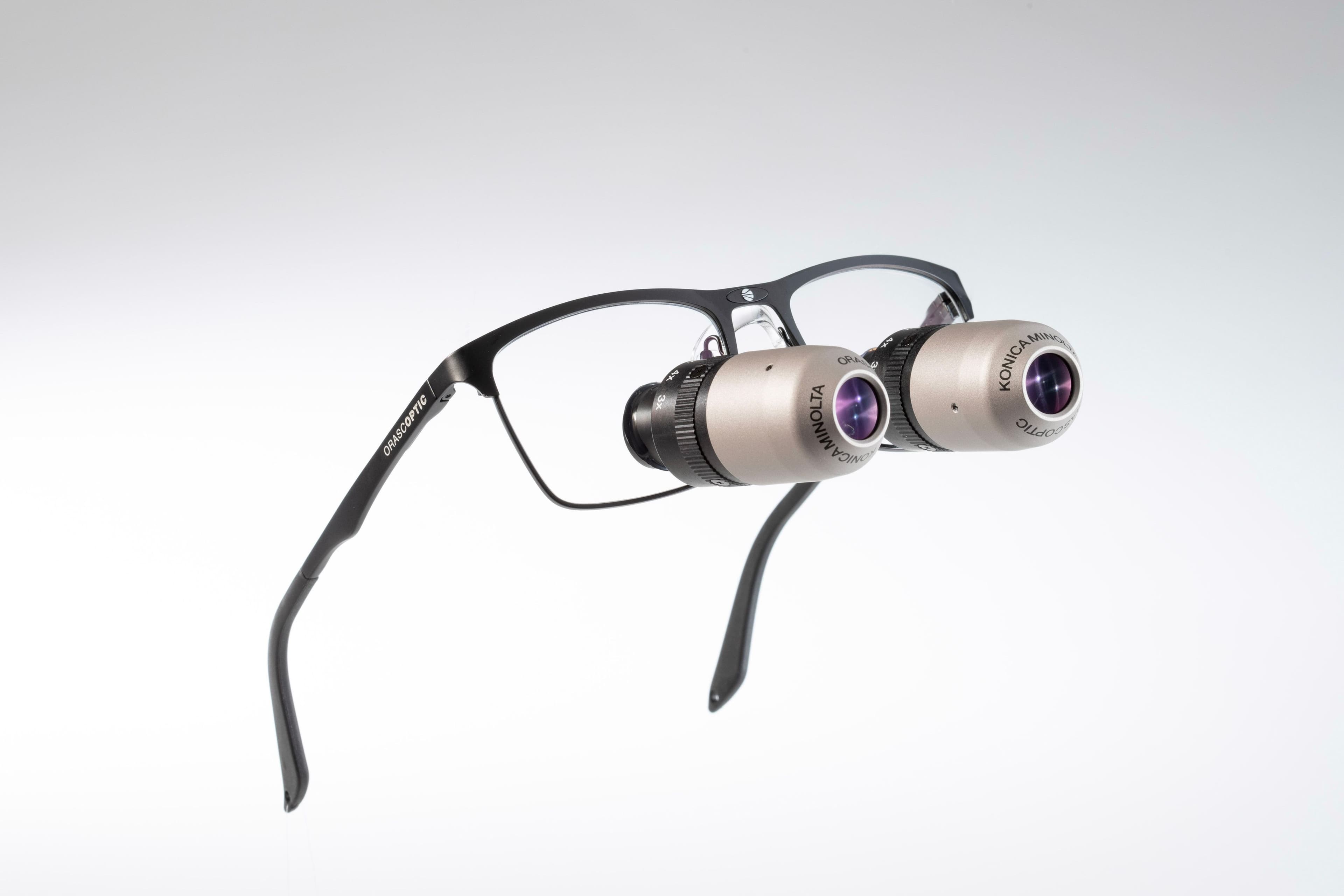
Surgical glasses are magnification systems designed for professionals who need to work with detail in clinical procedures. They are neither conventional glasses nor simple protective eyewear: they combine magnification, working distance, field of view and ergonomics to suit the specialty and working posture.
What surgical glasses are and when it makes sense to consider them
In the healthcare setting, the term surgical glasses is usually used to refer to surgical loupes mounted on a frame similar to glasses. Their main function is not to correct vision in general, although they can be integrated with prescription lenses when needed, but to provide stable magnification at a specific working distance.
The difference from conventional glasses lies in their intended use. Optical glasses correct refractive errors for everyday life or general work. A surgical loupe is designed to observe a limited field in greater detail, while maintaining an operating distance compatible with the professional’s technique.
It is also worth distinguishing them from protective eyewear. The latter prioritize the physical barrier against splashes or impacts, depending on the context of use. Surgical glasses, by contrast, are part of a magnification system. They may require complementary protection depending on the procedure, but their main criterion is optical and ergonomic.
This type of solution is considered when the professional needs sustained visual precision, repeatability in working distance and a more controlled posture during lengthy procedures. The decision does not depend only on “seeing larger”, but on choosing a configuration that fits the specialty, the operating field and the actual way of working.
At Optimedic, the Loupes for healthcare professionals section brings together magnification solutions, frames and headlight systems oriented to these needs.
Key criteria for choosing surgical glasses
The choice of surgical glasses should start with five variables: magnification, working distance, field of view, depth of focus and postural ergonomics. These factors are interconnected. Changing one may affect the rest, so they should be assessed as a whole.
| Criterion | What it determines | Practical question |
|---|---|---|
| Magnification | Level of visible detail | What degree of magnification does the task require? |
| Working distance | Separation between the eyes and the operating field | At what distance does the professional work without forcing posture? |
| Field of view | Area visible through the loupe | Is a wide or highly focused view needed? |
| Depth of focus | Useful margin of sharpness | Does the task require movement within a certain depth? |
| Ergonomics | Position of the neck, back and gaze | Does the configuration allow work without unnecessary postural compensation? |
Magnification: more is not always better
Magnification defines how much the image of the working field is enlarged. It is one of the most visible criteria when comparing loupes, but it should not be chosen in isolation. Higher magnification can be useful for detail work, although it can also reduce the field of view and make adaptation more demanding.
For general viewing procedures or the inspection of broad structures, moderate magnification may make sense. For techniques that require observing fine details, higher magnification levels can be considered. The decision should be linked to the specialty, prior experience with loupes and the type of movement the professional performs.
The guide on which magnification to choose in surgical loupes and depth of focus expands on this point in more detail and helps explain why magnification must be balanced with other optical parameters.
Working distance: the measure that connects optics and posture
Working distance is the separation between the professional’s eyes and the area they are working on. In surgical glasses, this measure is decisive because the loupe is configured to focus correctly at a specific distance.
If the distance does not match the user’s real working position, compensations may appear: the neck may be bent more, the torso brought closer or the shoulder position altered. That is why it should not be chosen based only on height or a generic chart. The patient or surgical field height, whether the user works seated or standing, and the usual technique all have a direct influence.
In a professional assessment, this distance is reviewed together with the declination angle, the frame and the type of loupe. The goal is for magnification to support the way of working, not force the professional to adapt to an unnatural posture.
Field of view: useful breadth during the procedure
The field of view is the area seen through the loupes. In practice, it determines how much of the surroundings can be seen without moving the head or refocusing constantly. A wide field may be comfortable in procedures where anatomical references are alternated or frequent spatial orientation is needed.
As magnification increases, the field of view may become narrower. This is not necessarily negative: in highly focused work it can be acceptable. However, for everyday use, the balance between detail and breadth is often more important than pursuing the highest possible magnification.
When trying on surgical glasses, it is worth reproducing habitual gestures: looking at the instrument, slightly shifting the point of attention, adjusting hand position or following a structure. This simulation helps detect whether the field of view is functional in the real context.
Depth of focus: room to work sharply
Depth of focus is the range within which the image remains sharp without significantly changing working position. In procedures where the working plane varies, this margin can influence comfort of use.
A greater depth of focus makes it easier to make small position changes without losing visual reference. By contrast, higher magnification configurations may require greater precision to keep the focal point. Again, the decision depends on the technique and the level of detail required.
This criterion is often overlooked in a first purchase, but it has an impact on continued use. For that reason, it is advisable to assess it together with magnification and working distance, not as a secondary feature.
Postural ergonomics: adapting the loupe to the professional
Ergonomics is not just about the frame being light or comfortable. In surgical magnification, it includes head position, viewing angle, nose support, frame stability and weight distribution when a headlight is added.
An appropriate configuration should allow the professional to maintain a posture consistent with their technique. If the loupe forces excessive neck flexion or raised shoulders, the visual benefit may be limited by postural strain.
The length of the workday also matters. Occasional use is not the same as integrating the loupes into several procedures per day. In prolonged use, frame stability, facial fit and compatibility with the illuminator become more important.
Available configurations: loupes, frames and illuminators
Surgical glasses are not a single closed product. They are usually configured by combining surgical loupes, a frame and lighting, depending on the professional’s needs. In the Optimedic catalogue within Orascoptic, these product families make it possible to build solutions adapted to different specialties.
Surgical loupes
Orascoptic surgical loupes are the core of the magnification system. They can meet different preferences in magnification, field of view, working distance and style of use.
When evaluating a loupe, it is worth checking whether the professional is looking for a solution to begin using magnification or whether they already have experience and want a more specific configuration. Those who are starting usually prioritize easy adaptation and visual balance. Those performing detail procedures may require more precise magnification or a specific optical geometry.
The way of use should also be considered: short procedures, lengthy interventions, seated work, standing work or alternating between different positions. These aspects influence the recommended magnification and distance.
Frames
The frame supports the optical system and determines part of the daily experience. It is not a minor accessory. A good frame choice helps stabilize the loupe, distribute weight and maintain adjustment during the procedure.
The frames for surgical loupes section groups options with different designs and adjustments. The choice depends on facial anatomy, the need for stability, compatibility with the selected loupe and user preferences.
The guide on how to choose a frame for surgical loupes explores factors such as nose support, fit, perceived weight and compatibility with lighting. It is useful reading when the optics have already been defined, but the most suitable support still needs to be chosen.
Headlights
Magnification changes the way the working field is viewed. That is why, in many contexts, frontal lighting is considered a complement to the system. A headlight aligned with the gaze can help illuminate the area observed through the loupes, especially when ambient or equipment light does not reach evenly.
Headlights for loupes should be considered together with the frame and the loupe, not at the end of the process. They add weight, change the balance of the set and can influence working autonomy depending on the configuration.
The choice should take into account the type of procedure, the need for mobility, the position of the operating field and the user’s tolerance to frontal weight. In some cases, the professional may prioritize maximum lightness; in others, more integrated lighting in their routine.
When to consider a custom configuration
A custom configuration is especially recommended when the professional will use surgical glasses regularly, works in a very defined posture or performs procedures with specific visual demands. It is also advisable if they have already used loupes and notice limitations in magnification, field, focus or comfort.
It is not just about choosing a model from the catalogue. Customization may include working distance, declination angle, frame type, prescription if needed, magnification and lighting. The final combination should answer a practical question: how that person works, for how long and with what level of detail.
There are signs that justify a technical review before deciding:
- Doubts between two close magnification levels.
- Need to alternate between several working planes.
- Prolonged use throughout the day.
- Procedures requiring fine detail and spatial orientation.
- Postural discomfort associated with working position.
- Need to integrate frontal lighting from the start.
In these cases, a conversation with a technician helps to prioritize needs. The goal is not to recommend the most complex option, but the one that fits the specialty, posture and expected adaptation curve.
Checklist before choosing surgical glasses
Before requesting a configuration, it is worth preparing some information. This helps make the assessment more accurate and avoids decisions based only on general preferences.
- Specialty and usual procedures. Not all techniques require the same level of detail or the same visual field.
- Working position. Seated, standing or alternating between both positions.
- Approximate distance to the operating field. It should reflect the real posture, not a forced one.
- Previous experience with magnification. Starting out, changing magnification or replacing a previous system.
- Lighting needs. Assess whether the field requires an integrated headlight.
- Use with prescription. Confirm whether built-in or compatible vision correction is needed.
- Frame preferences. Stability, lightness, facial fit and compatibility with other elements.
This preparation enables a more accurate recommendation. It also makes it easier to compare options using objective criteria, rather than focusing only on the frame’s appearance or the number of magnification levels.
Common mistakes when comparing surgical glasses
One of the most common mistakes is choosing based solely on magnification. Magnification matters, but it does not replace a properly measured working distance or suitable ergonomics. High magnification with a field that is too narrow may not be the most functional option for certain uses.
Another mistake is leaving the frame until the end. If the frame does not stabilize the system well or does not fit the face, the user experience may be affected even if the optics are appropriate. The same applies to the illuminator: adding it later without reviewing the balance of the system can change the perceived weight.
It is also worth avoiding decisions based solely on recommendations from other professionals. A configuration that works in one specialty, height, posture or routine may not be the most suitable for another user. External references can guide, but the final choice should be based on measurement and contextual testing.
Frequently asked questions
Are surgical glasses the same as surgical loupes?
In common use, surgical glasses usually refers to surgical loupes mounted on a frame-like structure. The loupe provides magnification and the frame allows it to be positioned stably. They should not be confused with conventional glasses or protective eyewear, although they may look similar from the outside.
What magnification should be chosen in surgical glasses?
It depends on the specialty, the level of detail required, previous experience and the working distance. Higher magnification is not always more appropriate, because it can change the field of view and depth of focus. The best approach is to assess magnification, posture and type of procedure together.
Why does working distance matter?
Working distance determines where the loupe focuses correctly. If it does not match the professional’s real posture, it may force them to get too close, flex the neck or change torso position. That is why it should be measured under conditions similar to normal use.
When should a headlight be added to surgical glasses?
A headlight is considered when the working area needs light aligned with the gaze or when ambient lighting does not adequately cover the magnified field. It should be chosen together with the loupe and the frame, because it affects weight, balance and use routine.
Is a custom configuration worthwhile?
It makes sense when surgical glasses will be used frequently, there are specific visual demands or the aim is to fine-tune posture, distance and magnification. A personalized assessment allows the specialty, technique, working position and preferences to be reviewed before defining the configuration.
Next step to configure surgical glasses
Choosing surgical glasses requires combining optics, ergonomics and working style. To review magnification, distance, frame and lighting with technical criteria, a personalized assessment can be requested through contact for surgical loupes.