

Surgery and equipment
OPELA in the operating room: when to consider wearable frontal lighting
A practical guide to assessing when wearable frontal lighting such as OPELA III Cx can complement overhead light in the operating room without limiting the team’s mobility.
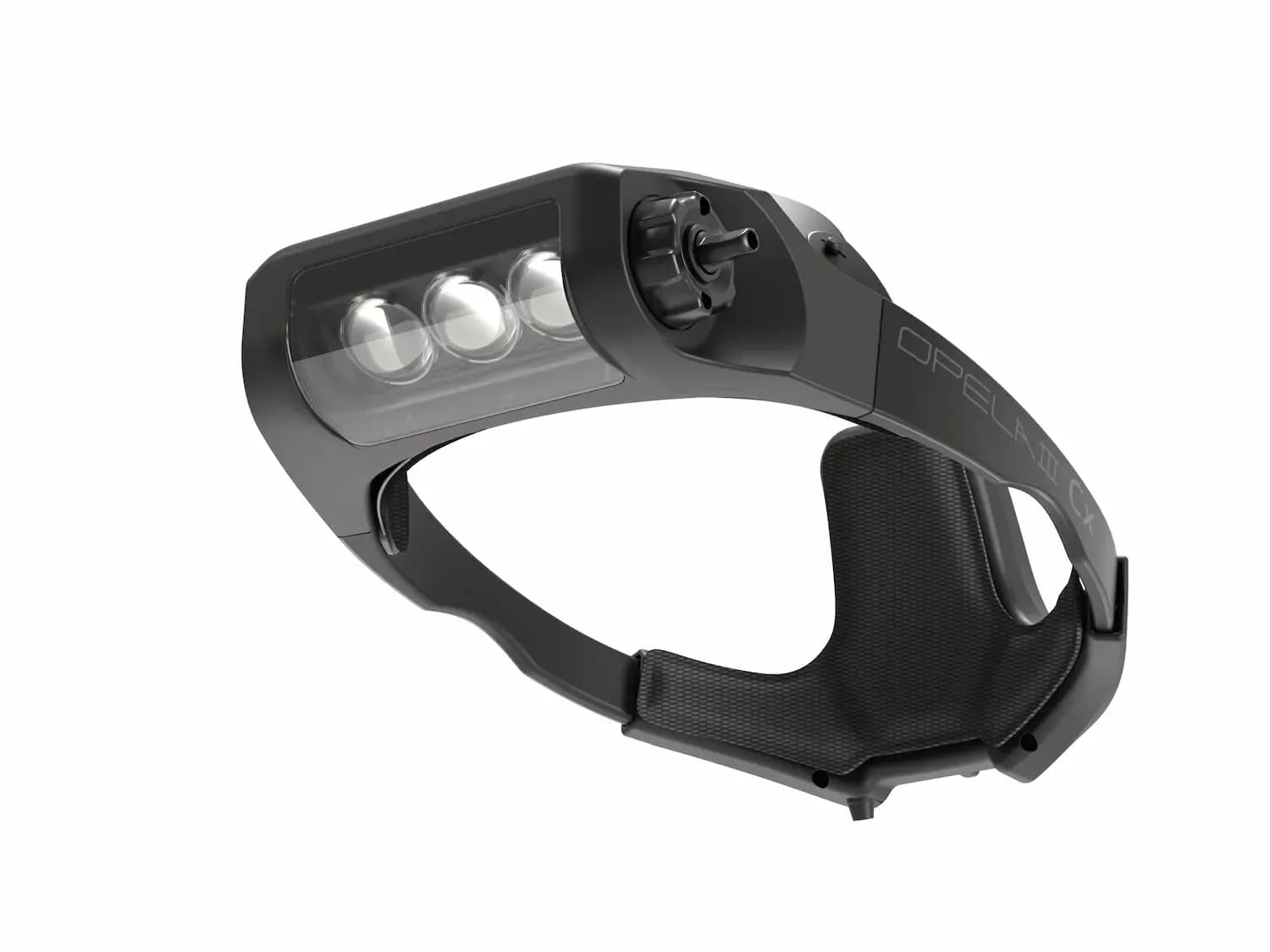
OPELA III Cx is a wearable frontal lighting system designed to complement general surgical lighting when the working field requires a directed, stable light source aligned with the professional’s line of sight, especially in situations where overhead light does not adequately support access or working position.
What problem OPELA solves when overhead light is not enough
General operating room lighting is the starting point for any procedure. However, it does not always align optimally with the surgeon’s visual axis. The patient’s position, the depth of the field, the instrument setup, the assisting staff, or the access angle itself can create shadows or reflections that require the main light to be readjusted.
In these contexts, wearable frontal lighting does not replace overhead illumination. Its role is different: to provide a directed light source from the professional’s perspective. The light follows head movement and is oriented toward the observed area, which can be useful when the area of interest changes frequently or is partially hidden from ceiling light.
The value of a solution such as OPELA III Cx lies in this relationship between gaze, position, and light. By carrying the light source on the professional, the beam moves with the visual field and can reduce reliance on continuous adjustments to the surgical lamp during certain moments of the procedure.
When wearable frontal lighting fits into the operating room
The decision to incorporate wearable lighting should be based on the type of procedure, the surgical environment, and the team’s working habits. The goal is not to add equipment by default, but to identify situations in which directed visibility offers an operational advantage.
It may make sense to consider OPELA III Cx when the professional needs the light aligned with their line of sight for specific periods, when access to the field is deep or narrow, or when movement around the table prevents the overhead lamp from being positioned ideally.
It may also fit in operating rooms where several professionals share the visual field from different positions. In those cases, a frontal light allows the person performing the procedure to have their own lighting point, without depending entirely on the main lamp axis or on adjustments made by others.
Directed visibility without changing the logic of the operating room
Wearable frontal lighting is especially interesting when the aim is to reinforce visibility without changing the organization of the surgical space. Because it does not depend on an overhead arm for each fine adjustment, it can more naturally follow changes in the professional’s position.
This does not mean every procedure requires it. In surgeries with a wide field, good exposure, and well-oriented overhead light, general lighting may be sufficient. The key is to determine whether shadows, angle changes, or field depth recur regularly.
Freedom of movement for the professional
In some procedures, the professional changes posture or moves to maintain an appropriate working angle. If each change requires repositioning the lamp or asking for adjustments, the team’s workflow can be disrupted.
A wearable lighting system can provide freedom of movement because the light source follows the user. This feature is useful in fields where the optimal position is not fixed or when the procedure requires alternating between different nearby areas.
Consistency of the light point
Another relevant criterion is consistency. Overhead light can be affected by obstacles between the lamp and the field: heads, hands, instruments, or equipment. Frontal lighting, being located along the professional’s axis, can maintain a light point that is more consistent with the direction of observation.
This consistency should be assessed in terms of ease of use, equipment balance, and integration with other elements: cap, shield, glasses, loupes, or protective systems. Before adopting any solution, it is advisable to test it under conditions as close as possible to real use.
Scenarios where portable lighting can complement general light
The most useful comparison is not between overhead light and wearable lighting as mutually exclusive alternatives. In the operating room, it is usually better to think in layers of lighting: a well-configured general base and directed support when the field requires it.
| Surgical scenario | Role of overhead light | Contribution of wearable lighting |
|---|---|---|
| Wide, well-exposed field | Sufficient primary lighting in many cases | May be unnecessary or used only as occasional support |
| Deep field or narrow access | Can create shadows depending on the angle | Reinforces the light point aligned with the line of sight |
| Frequent position changes | Requires lamp readjustments | Follows the professional’s movement |
| Work with several team members close to the field | May be partially blocked | Provides individual directed lighting |
| Procedures with areas that are difficult to visualize | Depends heavily on beam orientation | Helps illuminate the observed area from the working axis |
This qualitative reading helps avoid overly broad decisions. The question should not be whether a wearable light is “better” than an overhead light, but whether it adds value at specific moments when ceiling lighting does not fully solve the working field.
To expand on this approach, you can review the analysis of portable surgical lighting versus overhead lighting, which develops the practical differences between both approaches.
Practical criteria before considering OPELA III Cx
Before requesting information or a demonstration, it is advisable to review some internal aspects of the operating room. This preparation makes the evaluation more specific and avoids comparing equipment without a defined use case.
A useful checklist may include:
- Type of procedure in which lighting limitations appear.
- How often the overhead lamp needs readjustment.
- Presence of shadows caused by team position, instruments, or field anatomy.
- Need to move around the table during the procedure.
- Practical compatibility with other elements used by the professional.
- Team preferences regarding weight, fit, balance, and cleaning.
It is also advisable to observe whether the problem appears all the time or only at certain moments. In some operating rooms, directed lighting is justified for specific phases of a procedure, not necessarily for the entire surgical act.
Within the Optimedic Surgery area, this type of decision is approached from the use context: what the professional needs to see, how they move, what lighting is already available, and what level of directed support may be reasonable.
How to integrate frontal lighting into the workflow
Introducing wearable lighting should take the full surgical workflow into account. It is not enough to assess the perceived beam power; placement, adjustment, stability during movement, and ease of incorporating it into the team’s routine also matter.
In practice, the evaluation should be carried out with the same elements that will be used in the operating room. If the professional works with glasses, face protection, a cap, or magnification systems, the test should reproduce that setup. This way, it can be verified whether the equipment remains stable and whether the light point is aligned with the area of interest.
Lighting should also be understood as an extension of the visual axis. In this sense, the article on lighting as a natural extension of the surgeon’s vision can help structure visual ergonomics and beam direction criteria.
When the need is well defined, the next step is to review the available options within Surgery products and discuss the specific case with a specialist. This conversation makes it possible to distinguish between a specific need, an improvement to the existing lighting setup, or the suitability of adding a frontal solution.
Frequently asked questions
Does OPELA replace the operating room overhead light?
It should not be considered a direct replacement. OPELA III Cx is assessed as a wearable frontal lighting system to complement general light when the working field requires a directed source from the professional’s visual axis. Overhead lighting remains the foundation of the surgical environment.
When does it make the most sense to use OPELA in the operating room?
It makes the most sense when overhead light does not match the real working position well: deep fields, narrow access, frequent posture changes, or shadows created by equipment and instruments. The decision should be based on recurring situations, not on a general preference.
What should a team review before considering wearable lighting?
It is advisable to review which procedures present the issue, when shadows are created, how often the lamp is readjusted, and what elements the professional uses during the procedure. It is also important to assess comfort, balance, and alignment of the light point under conditions similar to real use.
Can a frontal light improve freedom of movement?
It can facilitate a more flexible workflow when the professional needs to change position and keep the light aligned with their line of sight. Even so, its usefulness depends on the type of procedure, the operating room environment, and how it integrates with the rest of the equipment.
Next step to evaluate OPELA III Cx
If the team identifies recurring limitations in directed lighting, they can review the OPELA III Cx product sheet and prepare an inquiry with the specific use case. To resolve questions about integration, configuration, or a demonstration, you can request information about OPELA III Cx from Optimedic.