Surgery and equipment
Portable Surgical Lighting vs Overhead: When a Wearable System Pays Off
We compare overhead surgical lighting with wearable portable systems: advantages in deep cavities, mobility and cases where the surgical headlight replaces or complements the ceiling lamp.
Overhead surgical lighting is the standard for general field vision, but leaves shadows in deep cavities and depends on the surgeon's position relative to the lamp. Wearable portable systems project coaxial light from the operator's head, resolve shadows and provide mobility. In modern practice both systems coexist more than they compete.
Overhead operating-room lighting: standard and limits
Overhead operating-room lamps are the main lighting system and a well-documented standard within surgical equipment. They provide very high luminance, broad field coverage and manual beam redirection.
Their limitations, however, are structural:
- Fixed position. The lamp is anchored to the ceiling. Light falls at a defined angle and, in deep cavities, the patient's own anatomy or the surgeon's hands generate shadows
- Postural dependence. If the surgeon shifts position or leans over the field, they stop receiving light at the optimal angle and the working area is partially shadowed
- Non-coaxial. Overhead light comes from a ceiling point, not from the surgeon's visual axis. This creates differences between what the eye sees and what light fully reaches
These limitations sharpen in small operating rooms, with several people around the patient, or in procedures with the surgeon's head heavily tilted over the field.
Wearable portable lighting: architecture
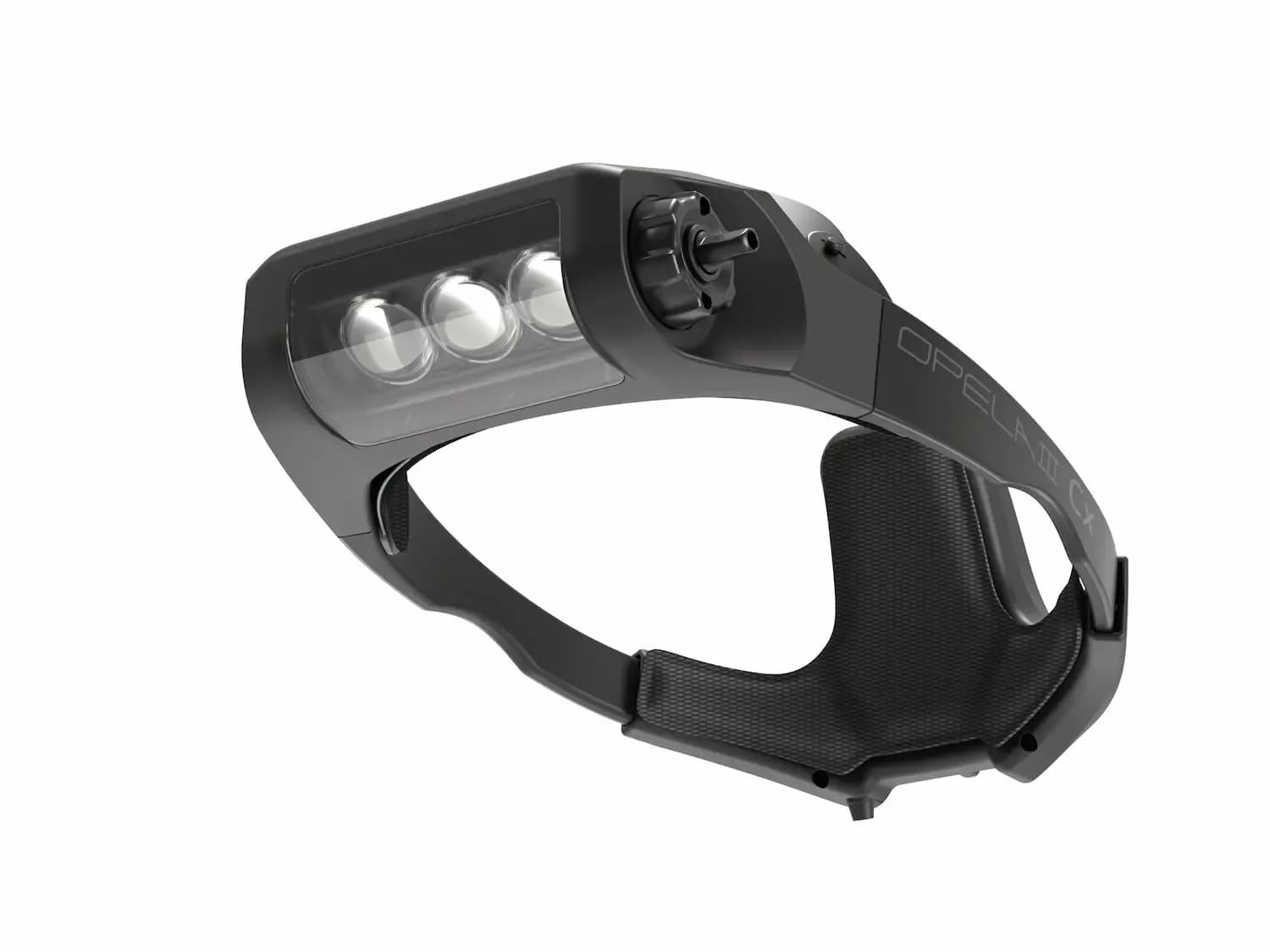
Wearable portable systems project light from the surgeon's own head. The LED module mounts on a headband, helmet or specific adapter, and the battery can be integrated into the module or worn in a belt pack.
The key difference is that light follows the gaze: wherever the surgeon moves, light hits the same plane where the eye focuses. It is real coaxial lighting.
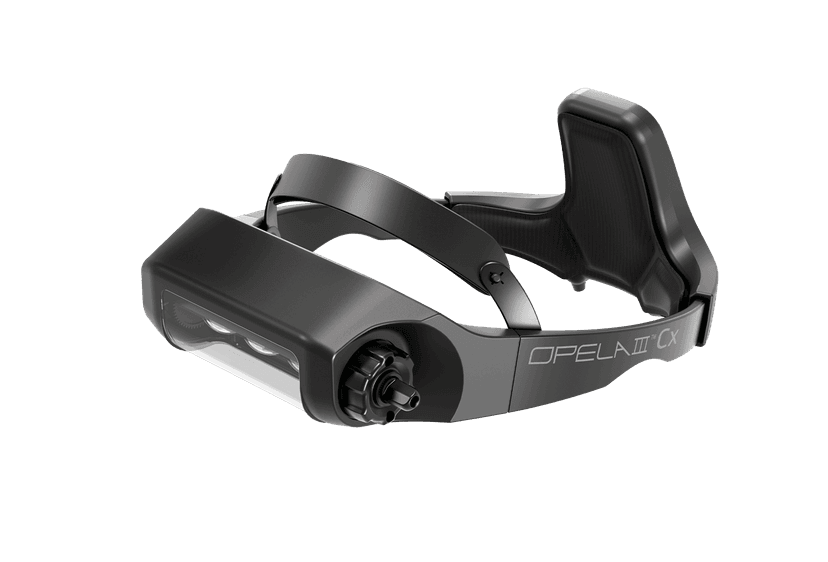
Systems such as OpelaIII Cx take this architecture to its most advanced form: wearable module with luminance comparable to an overhead lamp, full-day autonomy, intensity and beam control, and ergonomics designed for long sessions.
Technical comparison: overhead vs portable
| Parameter | Overhead lighting | Wearable portable system |
|---|---|---|
| Maximum luminance | Very high (160,000+ lux) | High (operating-room compatible) |
| Spatial coverage | Broad, configurable | Local, follows the surgeon |
| Shadows in cavities | Frequent | Minimal |
| Real coaxial lighting | No | Yes |
| Postural dependence | High | Low |
| Operator mobility | Limited | Total |
| Installation cost | High (infrastructure) | Low (no works) |
| Use outside fixed OR | No | Yes |
| Maintenance | Ceiling electromechanical | Portable equipment electrical |
Cases where the portable system changes the outcome
Five contexts where a well-specified wearable makes a clinical difference compared to overhead-only:
Surgery in deep cavities. Advanced ENT, oral surgery, gynecology, open urology, thoracic surgery. The overhead leaves shadows the wearable resolves through its coaxial angle.
Procedures with strongly tilted head. Spinal surgery, cranial neurosurgery in certain approaches, maxillofacial surgery. The surgeon blocks their own overhead light when leaning in; the wearable keeps illuminating because it travels with them.
Operating rooms shared with several operators. Overhead light is contested by several people around the patient. The wearable guarantees own light for the primary surgeon regardless of the rest of the team.
Non-conventional environments. Field hospitals, humanitarian missions, transfers, surgery in consultation. Without reliable overhead infrastructure, the wearable becomes the reference system.
Operating rooms with older or limited overhead. Centers without recent ceiling-equipment renewal. A wearable resolves the deficiency without works or infrastructure investment.
Cases where overhead alone is sufficient
Not every procedure requires a wearable. Overhead alone solves well:
- Superficial general surgery without deep cavity
- Brief procedures where the surgeon's posture remains stable
- Modern operating rooms with premium lamps and adequate beam control
- Surgeries with broad field and non-critical angle of incidence
In these contexts, adding a portable system delivers marginal benefit and adds a component the surgeon must wear.
Specifications to evaluate in a wearable system
Four parameters condition the clinical adequacy of the portable system:
- Useful luminance on the field: the relevant figure is not LED lumen output but luminance (lux) on the working plane at habitual head-to-patient distance. Professional systems deliver thousands of useful lux
- Beam size and shape: adjustable is preferable. Wide beam for general vision, narrow beam for deep cavities
- CRI (Color Rendering Index): 90+ to distinguish tissue nuances; 95+ ideal in procedures where color differentiation is critical
- Autonomy and ergonomics: full day without battery swap, reasonable weight on the head, comfortable adjustment system for long sessions
Frequently asked questions
Does a portable system replace the overhead lamp?
In most conventional operating rooms it doesn't replace it: it complements it. The overhead provides general vision and massive luminance; the wearable resolves shadows and delivers coaxial light where the surgeon's eye focuses. There are non-conventional contexts —mobile environments, ambulatory, field hospitals— where the wearable can be the only system.
Is it too heavy for a full surgical day?
Current wearable systems with integrated battery sit around 150-300 grams on the head, distributed in headband or helmet. Systems with belt pack can drop cephalic module weight to 80-100 grams. For 6-8 hour sessions, the decisive factor is weight distribution, not the absolute figure.
What autonomy does the battery offer?
Current professional systems cover 6 to 10 hours of continuous use at high intensity. For longer days or revisions, intra-session battery swap is routine and takes seconds.
How does luminance compare to a surgical overhead lamp?
The overhead has higher absolute figures, but the wearable concentrates light exactly where the surgeon's eye focuses, so perceived useful luminance can equal or exceed the overhead in deep cavities. The comparison is not lumen vs lumen, but lux on the real working field.
Can the wearable also be used outside the fixed operating room?
Yes. It is one of the structural advantages of portable systems: ambulatory surgery, specialized consultation, procedures in non-conventional rooms, itinerant training. The system's autonomy does not depend on fixed infrastructure.
Adopting portable surgical lighting in the operating room
The choice between overhead-only or combined overhead-plus-portable is not a binary decision. The overhead remains the base standard; the wearable adds specific capabilities that in certain specialties —deep cavity, tilted posture, non-conventional environment— elevate the clinical outcome.
Adoption is usually progressive: the surgeon who has tried a wearable in oral or ENT surgery rarely goes back to relying on overhead alone for those procedures.
To evaluate the implementation of OpelaIII Cx in your service, request technical information from the Optimedic team.