

Surgical Loupes
TTL Surgical Loupes: Selection Guide by Specialty
A guide to evaluating TTL surgical loupes based on magnification, working distance, field of view, depth of field, and ergonomics for precision work.
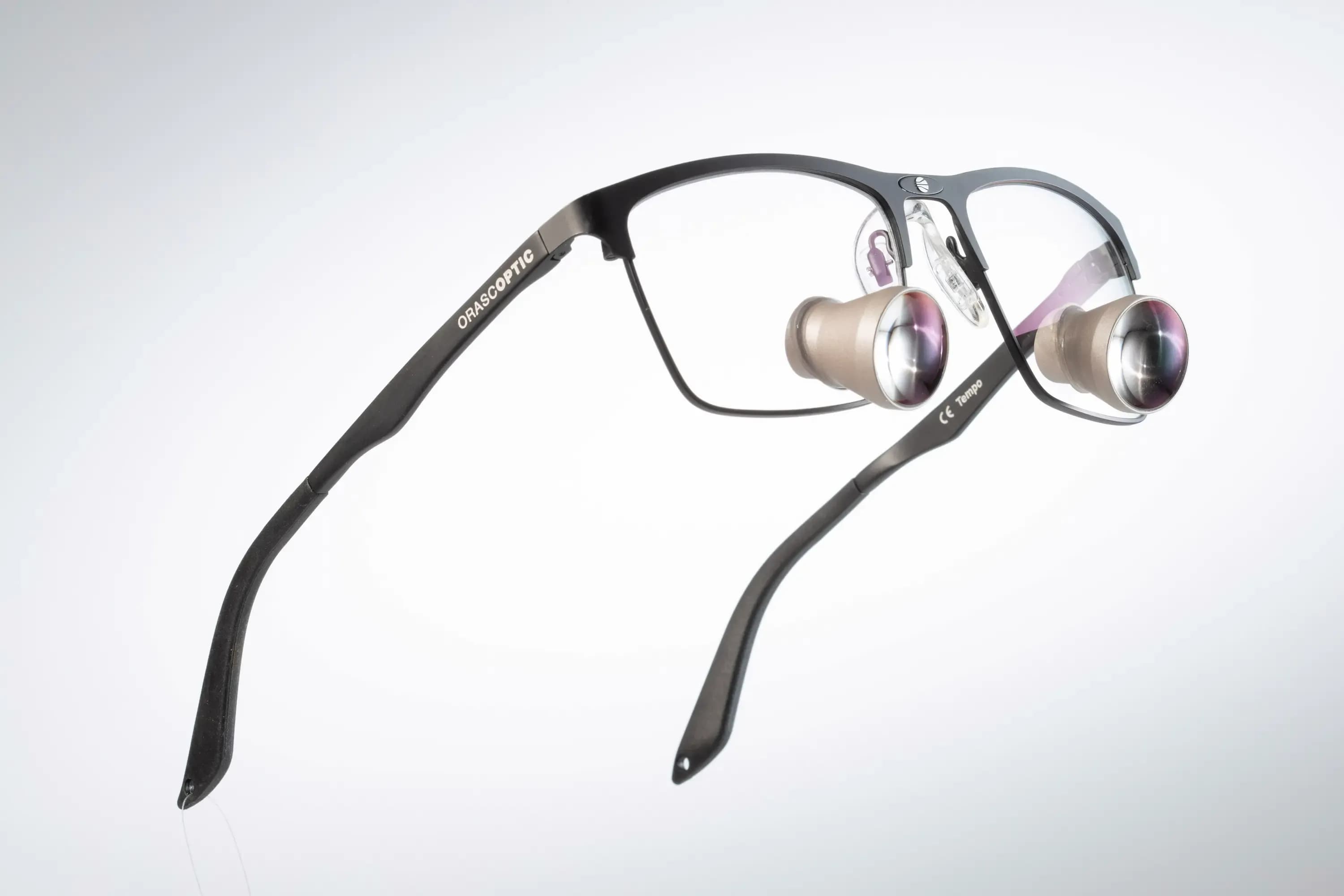
TTL surgical loupes are configured by integrating the eyepieces into the lens of the frame, with a declination angle and working distance defined for each professional. The choice should balance magnification, field of view, depth of field, and ergonomics according to the specialty and the type of procedure.
TTL surgical loupes: what this configuration involves
In TTL loupes, short for through-the-lens, the telescopes are mounted directly through the spectacle lenses. This distinguishes them from flip-up systems, in which the optical assembly hinges in front of the frame. The decision should not be approached as a mere aesthetic preference: it affects posture, visual axis, adaptation, and the way you work during precision procedures.
The TTL configuration is made by taking the professional’s measurements into account: interpupillary distance, working distance, declination angle, and the usual position of the head and torso. That is why two loupes with the same magnification can perform very differently if they are not adjusted to the user and their clinical environment.
This approach is relevant in specialties that require stable vision over small fields: restorative dentistry, endodontics, periodontics, implantology, oral surgery, microsurgery, surgical dermatology, or outpatient procedures requiring fine anatomical detail. To review available models and families, Optimedic brings together its range of surgical loupes for professionals within the Loupes by Optimedic division.
Main criteria for choosing TTL surgical loupes
Choosing surgical loupes is not about selecting the highest magnification available. A suitable configuration starts with the clinical task, the length of use, the working distance, and the professional’s tolerance to changes in the visual field.
| Criterion | What it determines | Useful question before choosing |
|---|---|---|
| Magnification | Level of perceived detail | Do you need overview vision, fine detail, or both? |
| Working distance | Cervical posture and patient position | At what distance do you naturally work? |
| Field of view | Visible area without moving the head | Does the procedure require broad context or a reduced focus? |
| Depth of field | Sharpness range forward and backward | Does the working area frequently change plane? |
| Declination angle | Viewing tilt | Does the posture require neck flexion? |
| Weight and frame | Comfort during prolonged sessions | Will they be worn for several hours a day? |
| Lighting | Visibility within the magnified field | Is ambient and coaxial light sufficient? |
These factors should be assessed together. High magnification can provide more detail, but it also usually requires greater control of distance and focus. A wide field helps orientation, but it may not be enough for very fine maneuvers. A well-defined working distance can promote a more stable posture, provided it reflects the way you actually work.
Magnification: more detail does not always mean a better choice
Magnification is one of the first specifications reviewed when comparing surgical loupes, but it should not be analyzed in isolation. In practical terms, it determines how much the surgical or clinical field is enlarged. As magnification increases, the sense of immersion changes, as do the field of view and the demand for stability.
For general procedures, the professional may prioritize a wider field that makes it easier to orient themselves and move quickly between areas. For precision work, such as endodontics, microsurgery, or peri-implant detail, higher magnification may be worth considering, provided the field of view and depth of field remain comfortable for the technique.
The key question is not “how much magnification can be used,” but “which magnification allows detailed work without losing control of the surroundings.” In a practice with several types of procedures, it is also worth considering whether you need a versatile solution or loupes tailored to specific indications.
In the Orascoptic surgical loupes available at Optimedic, the configuration is approached from real clinical use, not just the technical sheet. This helps avoid decisions based solely on the magnification number.
Working distance and posture: the ergonomic starting point
Working distance is the separation between the professional’s eyes and the treated area when adopting a functional posture. In TTL loupes, this measurement is critical because the eyepieces are integrated into a fixed configuration. If the distance does not match the actual working posture, the user may end up leaning too close, raising the shoulders, or flexing the neck.
To measure it usefully, a theoretical posture is not enough. The professional should be observed in a representative position: seated or standing, with the patient or field at the usual height, using the stool or equipment they use every day. In dentistry, for example, the chair position, the working quadrant, and four-handed technique all matter. In minor surgery or outpatient care, the stretcher, instrument tray, and height of the anatomical area all influence the choice.
A distance that is too short can increase the tendency to tilt the head. A distance that is too long can push the field away and make manipulation less intuitive. For that reason, TTL surgical loupes should be configured according to how the professional works, not according to a standard measurement.
Field of view and depth of field: balance for fluid work
The field of view is the area seen magnified through the loupes. Depth of field is the range in which the image remains sharp without readjusting posture. Both concepts determine how smoothly the procedure can be performed.
In precision work, a field that is too narrow may require frequent head movements to locate anatomical or instrumental references. Conversely, a wider field can help with orientation, although the level of detail perceived will depend on the chosen magnification.
Depth of field is important when the working area does not lie on a single plane. In procedures with depth variations, changes in angulation, or curved anatomical areas, a comfortable sharpness margin helps maintain visual continuity. If the depth of field is very limited, small changes in position can force constant postural readjustments.
That is why magnification, field, and depth should be assessed together. A balanced choice allows sufficient detail without turning every movement into a postural correction.
Ergonomics in TTL: declination angle, frame, and lighting
Ergonomics in TTL loupes depends on the relationship between the frame, the position of the eyepieces, and the user’s natural posture. The declination angle determines how far the gaze can drop without excessive head tilt. If the angle does not match the way you work, the professional may compensate with cervical flexion or by changing the height of the field.
The frame also matters. It must provide stability, fit, and compatibility with the user’s facial anatomy. During prolonged sessions, small discomforts at the bridge of the nose, the temples, or in weight distribution can become significant. Choosing the frame is not secondary: it is part of the optical and ergonomic configuration.
Lighting completes the system. As detail increases, it becomes more important that light reaches the field appropriately. A headlight can help when ambient light or equipment lighting does not align with the visual axis. The choice should consider weight, battery life, adjustable intensity, and comfort, without forgetting the real routine of the clinic or operating room.
In TTL loupes, ergonomics are not added at the end: they are defined from the measurements and the initial configuration.
How to adapt the choice to each specialty
Each specialty combines different needs for detail, mobility, and context. For that reason, TTL surgical loupes should be configured with specific procedures in mind, not only with a broad professional category.
Restorative dentistry and prosthodontics
In restorative dentistry and prosthodontics, it is often useful to maintain sufficient vision of the tooth, margins, adjacent tissues, and part of the instrumentation. The choice should balance detail and field so that references are not lost during preparation, isolation, or adjustment. Working distance is especially important, because the professional spends many hours in repeated positions.
Endodontics
In endodontics, the demand for detail is high. Locating canals, inspecting access cavities, and controlling deep areas require adequate magnification and lighting. Even so, depth of field should be considered, because the field is usually narrow and shadowed. An demanding configuration can make adaptation difficult if it is not tailored to the user.
Periodontics and implantology
In periodontics and implantology, general vision phases alternate with moments of fine detail. It may be necessary to observe soft tissues, margins, sutures, prosthetic components, or areas with limited access. In these cases, the field of view and postural stability help maintain a comfortable workflow.
Oral surgery, microsurgery, and outpatient procedures
In oral surgery and microsurgery, visual control of the field, depth, and lighting are decisive when working on small structures. In surgical dermatology and other outpatient procedures, the professional may need to enlarge lesions, edges, sutures, or superficial planes without losing mobility. In both contexts, working distance, the weight of the setup, and frame comfort are relevant criteria.
Recommended process for configuring TTL loupes
A professional choice can follow a simple sequence, but it must be carried out with technical criteria.
1. Define the priority procedures
Before discussing magnification, it is worth listing the procedures for which the loupes will be used. A solution for everyday general use is not the same as a configuration aimed at endodontics, oral surgery, or microsurgery. This stage helps avoid oversized or overly generic decisions.
2. Observe the real working posture
Measurements should reflect how the professional actually works. It is necessary to assess whether they sit or stand, the height of the field, the position of the arms and shoulders, and the tendency to flex the neck. Working distance is best defined in context.
3. Select a reasonable magnification range
Once the visual need is defined, magnification can be assessed. The recommendation should take into account prior experience with loupes, the type of procedure, and tolerance for narrower fields. Someone starting with magnification may require a different adaptation curve than an advanced user.
4. Check field, depth, and light
The chosen magnification should be tested together with the field of view, depth of field, and lighting. If the professional needs to move between planes or alternate between contextual vision and detail, these factors can matter as much as magnification.
5. Adjust the frame and ergonomics
The frame must fit stably and comfortably. It should also allow the eyepieces to align with the gaze and the intended declination angle. In TTL, an imprecise adjustment can affect the entire user experience.
To go deeper into this approach, you can consult the article on custom surgical loupe configuration.
Common mistakes when choosing TTL surgical loupes
When selecting TTL loupes, some mistakes recur frequently:
- Choosing the highest magnification without considering field of view or depth of field.
- Measuring working distance in a posture that does not reflect daily practice.
- Considering the frame only as an aesthetic element.
- Failing to assess the lighting needed for the type of procedure.
- Ignoring the user’s adaptation curve.
- Comparing models only by specifications, without relating them to the specialty.
Avoiding these mistakes does not require complicating the decision, but rather organizing the criteria. A good configuration comes from concrete clinical questions: what needs to be seen, for how long, at what distance, and with what posture.
The role of Optimedic as an official Orascoptic distributor
Optimedic distributes Orascoptic in Spain and supports the choice of surgical loupes with a technical approach. This guidance makes it possible to relate the specialty, posture, and visual needs to models, frames, and lighting suited to each case.
This support is useful when the professional is unsure between magnifications, needs to review their working distance, or wants to integrate TTL loupes with a headlight. It also helps frame the decision as a complete system: optics, ergonomics, frame, light, training, and after-sales service.
Those comparing options can start by reviewing the professional Optimedic catalogs and then request an assessment to configure the loupes according to their clinical practice.
Frequently asked questions
What does TTL mean in surgical loupes?
TTL stands for through-the-lens. In these loupes, the eyepieces pass through the frame lens and are configured using the user’s measurements, such as interpupillary distance, working distance, and declination angle. It is a customized solution that must be adjusted to the posture and type of procedure.
What magnification is suitable for precision work?
It depends on the specialty, experience with magnification, and the level of detail required. In precision work, higher magnification may be useful, but it should always be assessed together with field of view, depth of field, and lighting. High magnification does not compensate for an uncomfortable posture or an overly limited field.
Can working distance be calculated using a standard measurement?
It should not be chosen using only a generic measurement. Working distance should reflect the professional’s real posture, the height of the field, the position of the patient or stretcher, and the type of procedure. In TTL loupes it is especially important, because the configuration is integrated into the lens.
When is it advisable to add a headlight?
A headlight can be useful when the magnified field needs directed light aligned with the gaze. The decision depends on the procedure, ambient lighting, field depth, and length of use. The added weight and the comfort of the overall setup should also be considered.
Configure your surgical loupes with professional criteria
Choosing TTL surgical loupes means adjusting optics, ergonomics, and clinical use in a single decision. To move forward with a tailored configuration, review the Optimedic loupe and solution catalogs or request information to configure your surgical loupes with specialized technical advice.