

Surgical Loupes · Surgery and equipment
Surgical lighting and magnification: how to adjust light as detail increases
How the need for light changes when working at higher magnification, the role of depth of field, and when to consider a headlight in precision procedures.
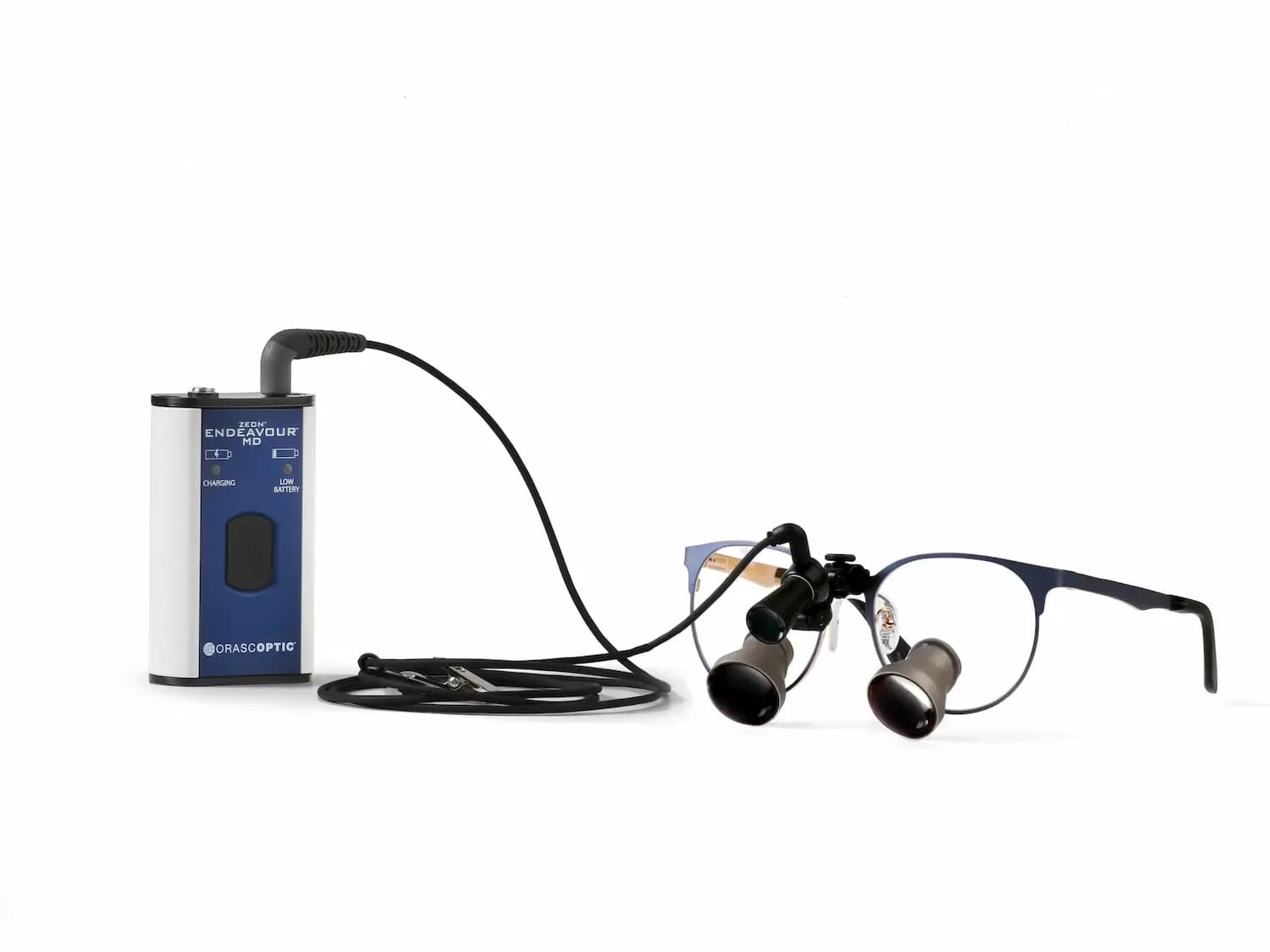
The surgical lighting must be adapted to magnification, because as the observed detail increases, the field of view, depth of field and perception of shadows all change. Well-directed light helps maintain visibility in the working area, especially when the procedure requires precision and a stable posture.
Surgical lighting, magnification and field of view
Magnification makes it possible to observe structures in greater detail, but it also changes the way the professional perceives the environment. As magnification increases, the field of view usually narrows: a more specific area is seen, with less peripheral information available at any given moment.
That change is not negative in itself. In precision procedures, concentrating vision on a reduced area may be necessary. However, it requires reviewing how light reaches the operative field, because small shadows or changes in orientation become more noticeable.
Depth of field also comes into play. At certain magnifications, the range in which the image remains in focus may be more limited. If the professional slightly changes the working distance or tilts the head, sharpness and effective illumination can vary at the same time.
For this reason, light should not be assessed as an isolated accessory. In a vision system with surgical loupes, magnification, working distance, declination angle and illumination are all part of the same configuration.
Why the need for light changes as magnification increases
When working at higher magnification, the eye concentrates on smaller details. In this situation, the quality of the lighting influences the ability to distinguish planes, edges, textures and changes in depth within a reduced field.
In addition, the environment itself can create shadowed areas. Instruments, hands, retractors or the anatomy of the treated area can partially block ambient light or operating room light. The more focused the observation, the more obvious this local loss of visibility may become.
Frontal surgical lighting can help in these cases because it follows the direction of the gaze. Because it is aligned with the visual axis, it illuminates the area toward which the head is oriented, reducing dependence on external sources placed at other angles.
This does not mean it always replaces operating room light or that it is necessary in every intervention. Its usefulness depends on the procedure, the chosen magnification, the working posture and the environment’s ability to provide homogeneous lighting in the observed area.
When a headlight may be helpful
A headlight is especially useful when the professional needs to direct light to the same point observed through the loupes. This may occur in deep areas, narrow cavities or procedures where instruments cast shadows over the working field.
It can also be useful when ambient light requires frequent position adjustments. If the professional changes head orientation to see better, a headlight allows the beam to move with that motion, maintaining a more stable relationship between gaze and illumination.
In lengthy procedures, set-up stability becomes important. It is not only about having more light, but about the overall system making it possible to work with a reasonable posture, a consistent working distance and visibility compatible with the chosen level of magnification.
The range of Orascoptic headlights allows light to be integrated into the loupe and frame configuration. The choice should take into account weight, balance, battery life and practical compatibility with the professional’s way of working.
Relationship with working distance and posture
Working distance affects both focusing and body position. If a loupe is configured for a specific distance, the professional should be able to maintain it without excessively leaning the head forward or raising the shoulders in search of visibility.
When the light does not follow the gaze well, there may be a tendency to compensate with the body: tilting the neck more, moving closer to the field or turning the head to avoid shadows. These adjustments may seem small, but they alter the coherence of the visual system.
Therefore, when selecting magnification and lighting, it is advisable to evaluate the whole setup under conditions as close as possible to real use. The question is not only whether detail can be seen, but whether it can be seen while maintaining the intended distance, posture and working field.
Surgical lighting should reinforce that configuration, not force it to change. At this point, frame, loupe, working distance and headlight selection should be addressed in a coordinated way.
Practical criteria for reviewing the set-up
Before adding or changing a light source, it is advisable to analyse how magnification is used in daily practice. The following criteria help structure the decision without reducing it to light intensity alone.
| Criterion | What to review | Why it matters |
|---|---|---|
| Type of procedure | Depth, field size and presence of cavities | Determines how much light actually reaches the observed area |
| Magnification level | Field of view and depth of field | The more detail, the more critical light orientation may become |
| Operating room environment | Position of lamps, shadows and instruments | External light may not cover all angles |
| Duration of work | Continuous use time of the system | Weight, balance and practical comfort become more important |
| Head movement | Need to follow the observation point | A frontal beam follows the direction of the gaze |
Review the procedure before the accessory
Not all procedures require the same combination. An intervention with a wide field and good ambient light has different needs from a manoeuvre in a deep or narrow area. For that reason, the starting point should be the intended clinical use, not just the power of the light.
Assess magnification under real conditions
Testing magnification on a bench or in a brief demonstration may not fully reflect daily work. It is important to check how the field of view and depth of field behave when usual postures are adopted and instruments are introduced into the field.
Observe the shadows that appear during the task
Shadows do not always come from a general lack of lighting. They often arise from the relative position of head, hands, instruments and external light. A headlight may be a solution when the shadow moves with the task and affects the observed point.
Integrating Orascoptic headlights into the loupe configuration
In a magnification setup, the headlight should be assessed together with the loupe and the frame. Weight distribution, beam position and the ease of orienting the light all influence the user experience.
Optimedic’s Loupes range makes it possible to approach this selection jointly, with Orascoptic surgical loupes and headlights designed to work as part of the same system. This integration makes it easier to consider light from the outset, rather than as a later correction.
It is also advisable to review complementary content on the relationship between vision and light. The article on lighting as a natural extension of the surgeon’s vision explains how light accompanies visual gesture and helps to understand its role in magnified work.
Frequently asked questions
Why does surgical lighting matter more at higher magnifications?
Because as the observed detail increases, the field of view narrows and depth of field can become more demanding. In that context, a small shadow or poorly oriented light can affect visibility at the working point more than in a lower-magnification observation.
Does a headlight replace operating room light?
Not necessarily. Operating room light remains important for illuminating the overall environment. The headlight provides directed light that follows the orientation of the head and can help when the observed point is in shadow or requires lighting more aligned with the gaze.
How do you know whether more light is needed or the loupe configuration should be changed?
It is advisable to first review the whole set-up: magnification, working distance, posture, viewing angle and shadows generated during the procedure. If visibility only improves by changing posture or moving closer to the field, it may be necessary to adjust the configuration, not just add more light intensity.
Does surgical lighting affect working posture?
It can have an indirect effect. If the light does not reach the observed point properly, the professional may tend to tilt the head or change the working distance to avoid shadows. Lighting aligned with the gaze helps keep the visual and postural set-up more coherent.
Configuring light as part of the system
Magnification and surgical lighting should be decided as a system: magnification, field of view, depth of field, working distance and posture all form the same chain. Reviewing only one element may leave the source of the visual difficulty unresolved.
To assess a configuration adapted to the procedure and working environment, you can request information about headlights and review the set of loupes, frames and lighting with technical advice.