

Surgical Loupes
EyeZoom Max: when to choose variable magnification over fixed
A guide to assess whether EyeZoom Max fits procedures with changing detail, field and depth, or whether it is better to keep a fixed-magnification surgical loupe.
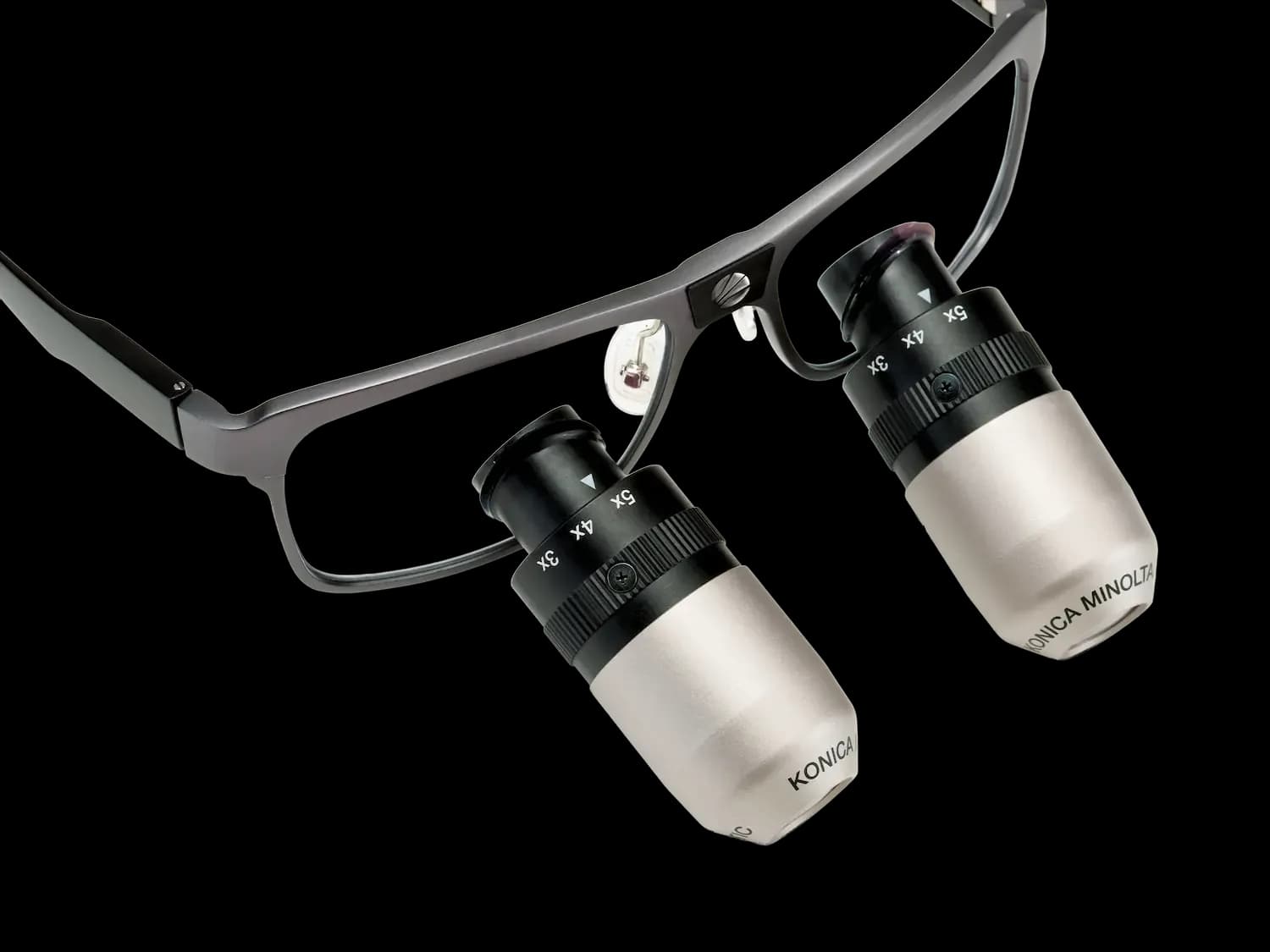
EyeZoom Max is a variable-magnification surgical loupe designed for professionals who alternate between a general overview and fine detail during the same procedure. Compared with a fixed-magnification loupe, it allows you to adapt magnification without changing equipment, provided the specialty, technique and user adaptation justify it.
EyeZoom Max and the role of variable magnification
In a surgical loupe, magnification is not just a number. It affects the apparent size of the field, depth of focus, spatial perception, image stability and the way the professional moves around the patient or the surgical field.
Fixed-magnification loupes maintain a constant magnification throughout the procedure. This simplifies the routine: the user knows their field, working distance and the optical response of the system in every movement. It is a common solution when the procedure is repetitive, the level of detail changes little, or the professional prioritises lightness and quick adaptation.
A variable-magnification loupe adds another layer of decision-making. It allows different magnification levels within the same system, so the professional can work with a broader view during orientation phases and increase detail when the technique requires it.
Within the Orascoptic range, EyeZoom represents this adjustable-magnification philosophy. EyeZoom Max takes the concept to a range intended for those who need greater detail within the same family. The choice should not be based on “more magnification” as an isolated criterion, but on how you work, for how long and with what degree of task variability.
What a variable-magnification loupe offers over fixed magnification
The main practical advantage of variable magnification is flexibility. In many procedures, not all phases require the same magnification. There are access, cleaning, preparation or overall review moments in which a wider field improves orientation. Afterwards, it may be necessary to visually approach a specific area with greater detail.
With a fixed loupe, this alternation is managed by choosing a compromise magnification. If a low or medium magnification is selected, you gain field and depth of focus, but detail may be lacking in delicate steps. If a high magnification is chosen, you gain detail, but the field narrows and the demand for visual stability increases.
With EyeZoom Max, the professional can adjust magnification within the same loupe. This can be useful when the procedure combines broad exploration phases with manoeuvres where more precise observation is desirable. The advantage is not in changing constantly, but in having different levels available when the workflow calls for them.
There is also an element of continuity. Instead of switching between several loupes or relying on a single magnification for everything, the variable loupe allows a coherent ergonomic and optical setup to be maintained. However, this flexibility requires judgement: each magnification change alters the perception of the field and may require visual and manual adaptation.
Criteria for deciding whether EyeZoom Max is worth it
Choosing EyeZoom Max means assessing the type of procedure, the level of detail required and the professional’s tolerance for a more versatile optical system. The following criteria help organise the decision.
Type of procedure and task variability
The first point is to analyse whether the intervention changes visual scale. In procedures where broad areas and fine detail alternate, variable magnification can provide operational comfort. Lower magnification helps maintain context; higher levels allow smaller structures to be observed with greater apparent detail.
By contrast, if the technique is performed almost always at the same visual scale, a fixed loupe may be more straightforward. For example, when the professional repeats highly standardised procedures with a stable working distance, a well-chosen fixed magnification may be sufficient and easier to integrate.
The useful question is not whether EyeZoom Max offers more possibilities, but whether those possibilities will actually be used in daily practice. An advanced configuration that does not match the clinical workflow can add complexity without providing practical value.
Changes in detail during the procedure
Variable magnification makes more sense when the professional needs to move from a panoramic view to detailed observation without leaving the same working field. This may occur in microsurgery, restorative dentistry, endodontics, periodontics, oral surgery, implantology or medical procedures where fine visual control is part of the technique.
Even so, the type of detail matters. It is not the same to need more magnification for a few specific seconds as it is to work for long periods at high magnification. If the detail phase is brief and predictable, a medium fixed loupe may cover most cases. If alternation is frequent, EyeZoom Max may offer a more suitable response.
Hand-eye coordination should also be considered. The higher the magnification, the larger movements appear and the smaller the visible field becomes. The professional must feel comfortable adjusting magnification without losing fluency in the technical gesture.
Field of view and depth of focus
The field of view is one of the most important criteria. In general terms, as magnification increases, the visible area tends to decrease. This means the professional sees more detail, but less surrounding context.
In a fixed-magnification loupe, the field is defined by the chosen configuration. In a variable loupe, the user can alternate between a wider field and a more focused one. This ability is useful when it is necessary to review the relationship between structures and then concentrate on a specific area.
Depth of focus is the range in which the image remains sharp without changing working position. As magnification increases, it usually becomes more demanding. EyeZoom Max allows magnification to be adjusted, but the user must understand how each level affects that sense of focus.
In procedures where work is carried out on a very stable plane, high magnification may be reasonable. In tasks with frequent movement or constant depth changes, it may be preferable to use moderate levels for longer and reserve the highest magnification for specific moments.
Adaptation curve
Adaptation to a surgical loupe depends on prior experience, working distance, posture, frame and specialty. With a variable-magnification loupe, the professional must also learn when to change levels and how to integrate that gesture into their routine.
EyeZoom Max may require a steeper adaptation curve than a fixed loupe, especially if the user comes from lower magnifications. It is advisable to test the feeling of field, depth and stability before deciding. It is also recommended to assess the full setup: frame type, frontal light, perceived weight and compatibility with the usual posture.
EyeZoom and EyeZoom Max within the Orascoptic range
The Orascoptic surgical loupe range includes fixed and variable magnification options for different professional profiles. Within the variable solutions, EyeZoom and EyeZoom Max address related, but not identical, needs.
EyeZoom is aimed at those seeking magnification flexibility in a range that allows switching between overview and detail. It may suit professionals who want to move from a fixed loupe towards a more adaptable solution without going straight to more demanding visual configurations.
EyeZoom Max is aimed at users who need a magnification range more focused on detail. It makes sense when the professional already knows they work with small structures, alternate scales of observation and can benefit from greater optical approach capacity within the same loupe.
The practical difference should not be understood as a universal hierarchy. There is no one right option for everyone. EyeZoom may be more balanced for certain profiles; EyeZoom Max may fit better when additional magnification is a real part of the procedure.
| Criterion | EyeZoom | EyeZoom Max |
|---|---|---|
| Typical profile | Professional seeking flexibility with gradual adaptation | Professional who needs more detail within a variable loupe |
| Use of high magnification | Occasional or moderate, depending on the procedure | More relevant in precision phases |
| Adaptation curve | Depends on prior experience | May be more demanding if coming from low magnifications |
| Key decision | Versatility without oversizing magnification | Alternation between field and detail with greater visual demand |
Before choosing, it is advisable to review the catalogues of loupes and optical solutions and compare the information with technical advice tailored to the specialty.
When fixed magnification may be the better fit
Variable magnification does not replace fixed loupes in every scenario. There are cases in which a fixed-magnification loupe remains a coherent and practical choice.
It may be a better fit if the professional always works with very similar procedures, at a stable working distance and with a constant need for detail. In that context, the simplicity of a fixed loupe facilitates repetition: there is no need to decide magnification levels or adjust perception during the procedure.
It may also be preferable if perceived weight and lightness are central priorities. Although comfort depends on the entire setup, a fixed loupe can be simpler for users who work long hours and do not need to alternate magnification.
Another common case is that of professionals who are introducing loupes for the first time. Starting with a fixed magnification can make it easier to learn working distance, posture and visual coordination. Later, if clinical practice requires it, a move to a variable solution can be considered.
The choice should not be framed as fixed versus variable in the abstract. It should answer a specific question: what kind of image does the professional need for most of their work, and how much does that need change within the same procedure.
Checklist for assessing EyeZoom Max before deciding
Before selecting EyeZoom Max, it is advisable to review a short list of clinical and ergonomic criteria. It does not replace a trial or technical advice, but it helps prepare the decision.
- Specialty and main procedures: identify whether detail techniques, broad procedures or a combination of both predominate.
- Frequency of visual change: assess whether there is a real alternation between general vision and fine detail.
- Previous magnification experience: consider whether the user comes from low, medium or high magnifications.
- Working distance: check that the setup fits the posture and usual environment.
- Acceptable field of view: determine how much context the professional needs to work safely and smoothly.
- Required depth of focus: assess whether work is done on stable planes or with frequent height changes.
- Integration with lighting: consider whether a headlight will be used and how it affects the balance of the setup.
- Adaptation time: anticipate a gradual transition, especially if the higher magnification will be used frequently.
This analysis makes it possible to distinguish between wanting more magnification and needing a variable tool. EyeZoom Max makes sense when optical versatility translates into a way of working that better matches the professional’s technique.
How to request advice according to specialty
Loupe selection should not be based solely on a product sheet. The same loupe may behave differently depending on working distance, frame, declination angle, lighting and the type of procedure.
To assess EyeZoom Max, it is advisable to prepare three pieces of information before requesting advice: which procedures are performed most often, what magnification is currently used if loupes are already part of the workflow, and what limitations are perceived in field, detail or posture.
With that information, a technician can guide the choice between EyeZoom, EyeZoom Max or another fixed-magnification configuration. The aim is to match the loupe to professional practice, not to choose the most complex option by default. To review possibilities and resolve configuration questions, you can request information about surgical loupes.
Frequently asked questions
Does EyeZoom Max replace a fixed-magnification loupe?
EyeZoom Max does not necessarily replace a fixed loupe. It is an option for professionals who need to alternate magnification levels during work. If the routine is stable, the procedure changes little and the user prioritises simplicity, a fixed-magnification loupe may still be more suitable.
When is EyeZoom Max worth choosing?
EyeZoom Max may be worth it when the professional alternates between a general overview and fine detail within the same procedure. It may also be useful if they already work with medium or high magnifications and need more flexibility. The decision should consider field of view, depth of focus and adaptation.
Are EyeZoom and EyeZoom Max for the same profile?
EyeZoom and EyeZoom Max share the logic of variable magnification, but they may suit different profiles. EyeZoom may fit those seeking versatility with a gradual transition. EyeZoom Max usually makes more sense when additional detail is a frequent need in daily practice.
Is it difficult to adapt to EyeZoom Max?
Adaptation depends on prior experience, the magnification used and the complete setup. A user accustomed to low magnifications may need more time to work at higher levels. Trial and technical adjustment help assess whether the field, focus and posture are appropriate.
What information is useful to provide before requesting advice?
It is useful to indicate the specialty, the usual procedures, the approximate working distance, current use of loupes and any perceived limitations. It is also helpful to explain whether field, detail, lightness or postural stability are priorities. With that information, the recommendation can be better tailored.
Next step for choosing the right setup
EyeZoom Max is an interesting option when variable magnification answers a real need to alternate between field and detail. If the routine is stable, a fixed magnification may be enough. To make a well-founded decision, the most useful approach is to compare specialty, technique and setup with personalised advice.