
Surgical Loupes
Dragonfly PRO vs Dragonfly NEO: how to choose an integrated frame
Professional comparison between Dragonfly PRO and Dragonfly NEO: integrated lighting, compatibility with Orascoptic loupes, batteries, and selection criteria.
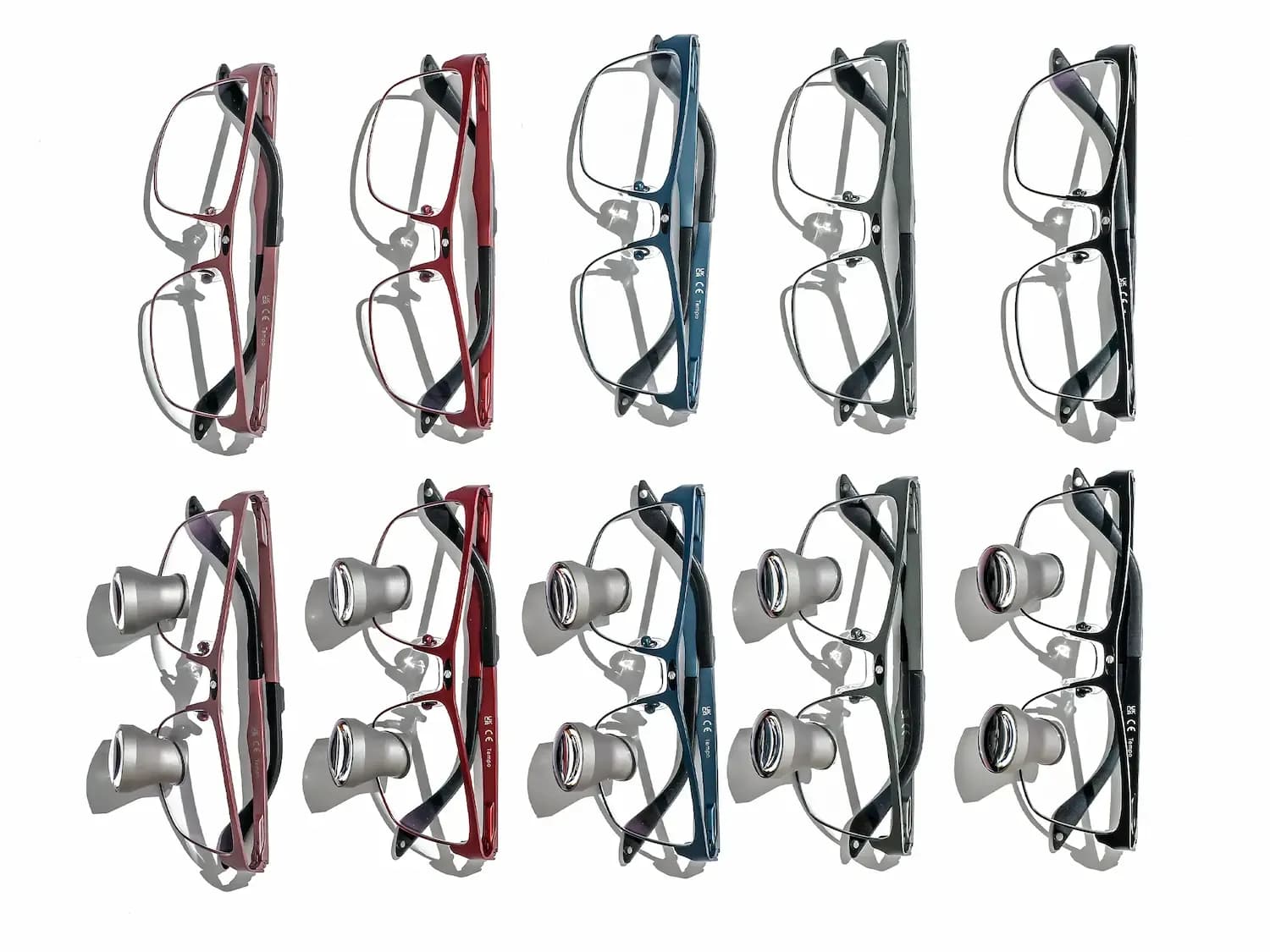
Dragonfly PRO and Dragonfly NEO are Orascoptic frames with integrated illuminator, battery, and electronics, designed to work without cables or an external pack. The choice depends on compatibility with the loupe, intensity management, the number of batteries included, and the disinfection needs of each clinical setting.
Dragonfly PRO and Dragonfly NEO: what they have in common
Both frames belong to the DragonFly family from Orascoptic and share a clear idea: integrating lighting into the frame itself. This avoids the use of a cable between the headpiece and an external pack, a relevant detail in clinics and operating rooms where mobility, an orderly workspace, and field cleanliness matter.
Both Dragonfly PRO and Dragonfly NEO incorporate the illuminator, battery, and electronics within the frame structure. For the professional, this means the basic light setup does not depend on an external module attached to a gown, belt, or pocket.
They also share two lighting parameters that are useful for assessing light quality: CRI 95 and a color temperature of 6.500 K. CRI, or color rendering index, indicates how faithfully a light source allows colors to be perceived. A color temperature of 6.500 K is in the cool range, commonly used in clinical lighting for its clear perception of the working field.
The decision, therefore, is not based on whether one offers integration and the other does not. Both do. The difference lies in how each model handles operating autonomy, intensity adjustment, telescope compatibility, and finish resistance to cleaning protocols.
Comparison table: Dragonfly PRO vs Dragonfly NEO
Before going into the selection criteria, it is worth looking at the main differences in summary form. The table includes only the relevant data for comparing both models without adding unspecified features.
| Criterion | Dragonfly NEO | Dragonfly PRO |
|---|---|---|
| Frame type | Frame with integrated lighting | Frame with integrated lighting |
| External cable | No | No |
| External pack | No | No |
| CRI | 95 | 95 |
| Color temperature | 6.500 K | 6.500 K |
| Intensity | 98 lm | Two levels: 66 and 98 lm |
| Batteries included | 4 batteries | 6 batteries |
| Finish | DragonFly integrated frame | Ceramic finish resistant to disinfectants |
| Compatibility | HDL 2.5 Macro, HDL 3.0, HDL 3.5x, and HDL Ergo 3.5x | Entire Orascoptic telescope line |
The comparison shows that Dragonfly NEO is a straightforward option when the loupe configuration matches its compatible telescopes. Dragonfly PRO expands the range of choice, especially if the professional needs compatibility with any Orascoptic telescope or wants two intensity levels.
Key differences when choosing Dragonfly PRO
The first relevant difference of Dragonfly PRO is intensity adjustment. Compared with the fixed intensity of 98 lm on Dragonfly NEO, PRO includes two levels: 66 and 98 lm. This makes it possible to adapt the lighting to different work situations, visual preferences, or procedural needs, without changing the light system.
This is not about promising a specific clinical effect, but about controlling the visual environment. Some professionals prefer to work always with a high, constant intensity; others alternate levels depending on the field, the time of use, or the contrast they seek during the procedure.
The second difference is the number of batteries included. Dragonfly PRO includes 6 batteries, while Dragonfly NEO includes 4 batteries. In a day with several work blocks, having more available batteries can make internal team organization easier, always within the charging and usage protocols defined by the manufacturer.
The third difference is the finish. Dragonfly PRO incorporates a ceramic finish resistant to disinfectants, a particularly important aspect in settings where the frame is cleaned frequently between procedures or users. Material and finish selection do not replace the hygiene protocol, but they can be a practical criterion for teams with high activity turnover.
Finally, compatibility makes a decisive difference. Dragonfly PRO is compatible with the entire Orascoptic telescope line, which broadens the options when selecting magnification, optical type, working distance, and ergonomic preferences. If the professional already works with Orascoptic telescopes or is considering a specific configuration, this point may tip the balance.
To review the model in detail, you can consult the Dragonfly PRO frame datasheet.
When Dragonfly NEO is the better fit
Dragonfly NEO is intended for those looking for an integrated frame, without cables or an external pack, with a straightforward lighting configuration. Its 98 lm intensity and 4 included batteries offer a clear proposition: integrated light in the frame, with no need to switch between several intensity levels.
It is particularly suitable when the professional works, or plans to work, with one of the compatible telescopes: HDL 2.5 Macro, HDL 3.0, HDL 3.5x, and HDL Ergo 3.5x. If the chosen loupe falls within this range, NEO makes it possible to access the DragonFly concept with a more limited configuration.
This narrower scope can be an advantage when the team already has a defined magnification requirement. Instead of comparing the entire telescope line, the decision focuses on confirming whether one of these models suits the procedure, working distance, and the professional’s posture preference.
It may also be suitable for clinics that want to standardize configurations across several users. If everyone works with telescopes compatible with NEO, selection becomes simpler and there are fewer variables to review during the purchase.
The Dragonfly NEO integrated lighting datasheet allows you to confirm this compatibility before moving forward with the loupe and frame selection.
Compatibility with Orascoptic loupes: the point not to leave until the end
In an integrated lighting frame, compatibility is not a secondary detail. The selection should coordinate frame, telescope, working distance, and lighting needs from the outset. Separating these decisions can lead to combinations that do not reflect the professional’s real use.
Dragonfly NEO accepts a specific telescope selection: HDL 2.5 Macro, HDL 3.0, HDL 3.5x, and HDL Ergo 3.5x. This list is enough for many profiles, but it does not cover the entire Orascoptic family. That is why, if the preferred option falls outside these models, it is worth considering Dragonfly PRO.
Dragonfly PRO, being compatible with the entire Orascoptic telescope line, offers more room to customize the configuration. This breadth may be especially relevant in specialties that require specific magnifications, certain fields of view, or a very defined working posture.
Professionals who have not yet chosen a loupe should first review the range of available Orascoptic frames alongside the telescope options. In magnification systems, the frame is not just a support: it influences the balance of the set, light integration, and the user experience throughout the day.
Practical decision criteria
A comparison between Dragonfly PRO and Dragonfly NEO should end with a concrete question: what configuration does the professional need for daily work? These criteria help organize the decision.
1. Planned or already used telescope
If the professional already knows they will work with HDL 2.5 Macro, HDL 3.0, HDL 3.5x, or HDL Ergo 3.5x, Dragonfly NEO may be sufficient from a compatibility standpoint. If they want to keep the choice open to any Orascoptic telescope, Dragonfly PRO offers more flexibility.
This criterion is usually the first because it conditions all the others. A frame may be attractive because of its lighting, but it must be compatible with the optical system that will actually be used.
2. Need to adjust intensity
Dragonfly NEO offers an intensity of 98 lm. Dragonfly PRO lets you choose between 66 and 98 lm. For professionals who prefer to adapt the lighting to the procedure or environment, PRO’s two levels add flexibility.
By contrast, if a simpler configuration is desired, with no intensity selection, NEO offers a direct proposition. The key is whether the user wants additional control or prefers to reduce adjustments during work.
3. Battery organization
NEO includes 4 batteries and PRO includes 6. The difference may be relevant for teams with long days, consecutive shifts, or several procedures in a row. It does not, by itself, imply a different clinical performance, but it does affect usage and recharging planning.
Before choosing, it is worth thinking about how accessories are managed in the clinic: who charges the batteries, where they are stored, and how rotation among users is organized.
4. Frame cleaning and disinfection
Dragonfly PRO incorporates a ceramic finish resistant to disinfectants. This point may carry more weight in settings with frequent cleaning protocols or intensive use of the equipment. The finish resistance helps frame it as a working tool subject to routine maintenance.
In any case, cleaning must be carried out according to the applicable product instructions. Finish resistance does not replace usage, storage, and disinfection recommendations.
5. Individual use profile or clinical team
For an individual professional with an optical configuration already defined within NEO compatibility, the choice can be simpler. For teams with multiple profiles, specialties, or magnification preferences, PRO provides more flexibility thanks to compatibility with the full Orascoptic line.
This difference also matters if the clinic plans to add new loupes in the future. A frame with broader compatibility can make adaptation to different configurations easier.
Which profile fits each frame best
Dragonfly NEO fits professionals who want an integrated frame, without cables or an external pack, and who work with the defined compatible telescopes. It is a coherent option when 98 lm intensity matches the way they work and there is no need to adjust between levels.
Dragonfly PRO fits those looking for more lighting adjustability, more included batteries, a ceramic finish resistant to disinfectants, and compatibility with the entire Orascoptic telescope line. It is also especially interesting when the loupe selection has not yet been finalized.
In clinics with multiple users, the decision can be approached in a mixed way. Some profiles may work with NEO if their telescope is compatible, while others may require PRO because of magnification, ergonomics, intensity adjustment, or cleaning protocol.
To broaden the context of PRO use, you can read the article on Dragonfly PRO in long surgeries, focused on its integration and approach for demanding days.
Frequently asked questions
Is Dragonfly PRO compatible with more telescopes than Dragonfly NEO?
Yes. Dragonfly PRO is compatible with the entire Orascoptic telescope line. Dragonfly NEO supports HDL 2.5 Macro, HDL 3.0, HDL 3.5x, and HDL Ergo 3.5x. Therefore, if the loupe choice is still open or requires another telescope, PRO offers more configuration flexibility.
What lighting difference is there between Dragonfly PRO and Dragonfly NEO?
Dragonfly NEO offers 98 lm. Dragonfly PRO adds two intensity levels, 66 and 98 lm. Both models share CRI 95 and a color temperature of 6.500 K. The main difference is not in the light tone, but in the ability to adjust intensity on PRO.
Do Dragonfly PRO and Dragonfly NEO need a cable or external battery?
No. Both models integrate the illuminator, battery, and electronics into the frame itself. This setup avoids cables and an external pack, simplifying the loupe and lighting system. The choice between one and the other depends on compatibility, intensity, included batteries, and finish.
When should you choose Dragonfly PRO over Dragonfly NEO?
Dragonfly PRO is suitable when compatibility with the entire Orascoptic line, two intensity levels, 6 included batteries, or a ceramic finish resistant to disinfectants is needed. Dragonfly NEO fits when the planned telescope is within its compatibility range and a more limited integrated configuration is desired.
Advice for choosing frame, lighting, and loupe
The choice between Dragonfly PRO and Dragonfly NEO should be made together with the selection of telescope, working distance, and lighting requirements. Reviewing these elements together avoids partial decisions and makes it easier to build a coherent configuration.
To assess compatibility, intended use, and frame options, request technical advice on Orascoptic frames with integrated lighting. A specialist can help compare Dragonfly PRO, Dragonfly NEO, and compatible loupes before defining the final configuration.