Surgery and equipment · Clinical applications
Power-Assisted Liposuction with MicroAire PAL vs Traditional Liposuction: Technical Advantages
We compare power-assisted liposuction with MicroAire PAL against traditional manual liposuction: cannula control, surgeon fatigue and technical efficiency in plastic surgery.
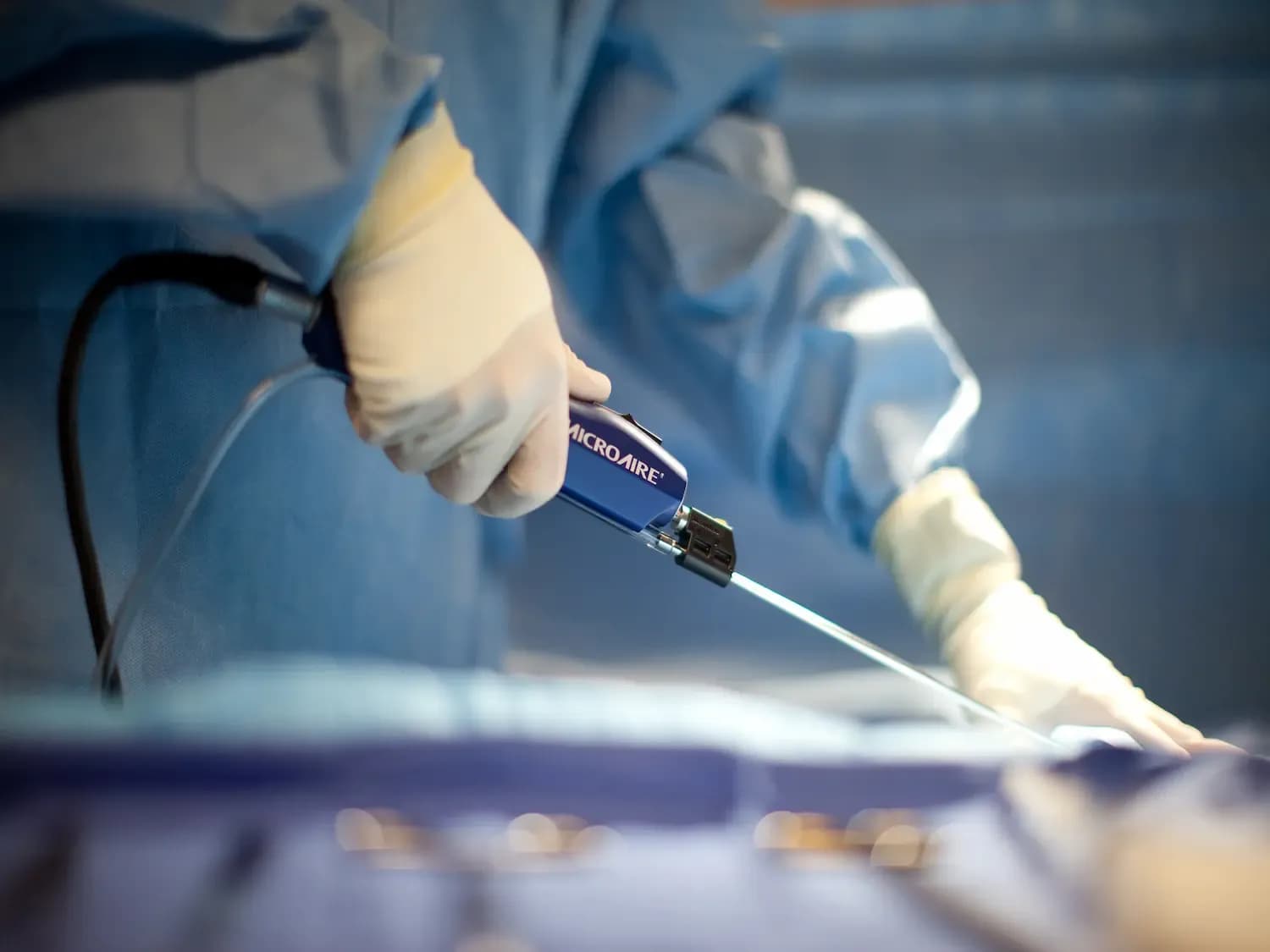
Power-assisted liposuction with MicroAire PAL adds an axial vibration mechanism to the cannula that reduces the surgeon's manual effort and improves tissue control. Compared to traditional liposuction, it offers higher efficiency in fibrotic zones, less fatigue during long sessions and a more reproducible technique.
How traditional liposuction works
Manual or traditional liposuction is performed through repetitive back-and-forth movement of the cannula by the surgeon. The reciprocating motion mechanically fragments adipose tissue, which is aspirated by vacuum into the collection canister.
It is a mature, well-standardized technique with low equipment cost. However, it has documented limitations within surgical equipment: the surgeon's physical effort accumulates throughout the procedure, efficiency decreases in zones with fibrous or scar tissue, and result quality can depend on the muscular fatigue accrued at the end of the session.
How MicroAire PAL power-assisted liposuction works
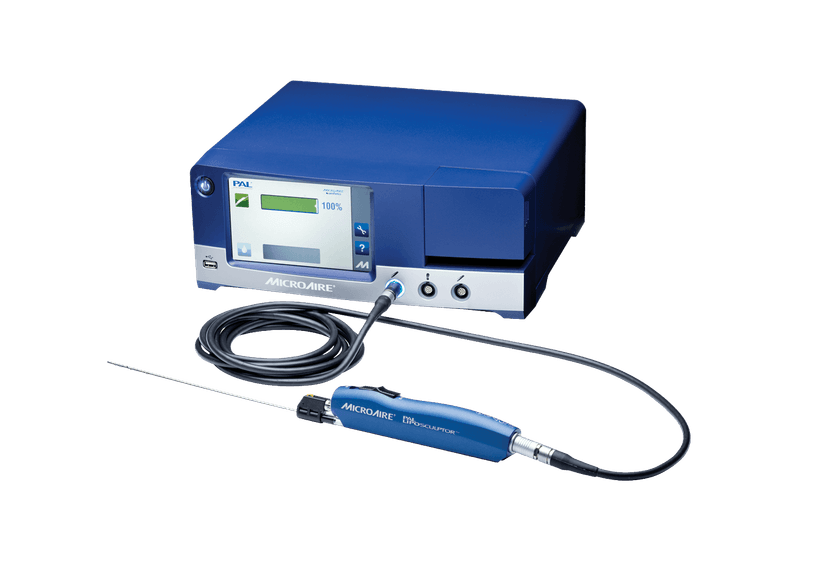
PAL technology (power-assisted liposuction) incorporates a pneumatic motor that imparts high-frequency, low-amplitude axial vibration to the cannula. The cannula does not rotate: it oscillates longitudinally a few millimeters, tens of times per second.
This mechanical vibration performs the fragmentation work that the surgeon would have to execute manually through reciprocating motion. The cannula advances through the subdermal plane with much less resistance, and the operator can focus on directional control and pressure rather than on the strength of displacement.
The MicroAire PAL system is operated through a foot control, fed by medical gas, with reusable or disposable cannulas depending on the center's protocol.
Technical comparison: control, fatigue and reproducibility
| Parameter | Traditional liposuction | MicroAire PAL power-assisted |
|---|---|---|
| Tissue fragmentation | Manual (surgeon reciprocation) | Mechanical axial vibration |
| Operator physical effort | High | Low |
| Efficiency in fibrous tissue | Limited | High |
| Efficiency in revision cases | Limited | Improved |
| Learning curve | Standardized, well documented | Brief initial adaptation |
| Accumulated fatigue in long sessions | Significant | Reduced |
| Session-to-session reproducibility | Depends on physical state | More consistent |
| Equipment cost | Low | Higher initial investment |
Clinical advantages in fibrotic zones and revisions
Two contexts in which power-assisted liposuction shows the most marked technical differences versus the manual approach:
Fibrous tissue. Zones such as the back, male flanks or gynecomastia present a connective tissue density that offers mechanical resistance to cannula advancement. PAL axial vibration fragments this tissue more uniformly, without the surgeon having to apply increasing force.
Revision surgery. In patients with previous liposuction, scar tissue makes the advancement of a traditional cannula more difficult. The assisted system reduces the risk of sudden movements caused by the overpressure required to overcome scar resistance.
In both scenarios, clinical outcome does not depend on the surgeon's residual energy after two or three hours of procedure, which translates into a more reproducible technique between sessions.
When manual technique remains valid
Manual liposuction is not an obsolete technique. It remains valid and, in certain contexts, preferred:
- Small volumes and accessible zones: investment in assisted equipment is not justified for occasional cases
- Centers with specific learning curve: teams trained in manual technique can maintain quality without changing systems
- Procedures linked to delicate fat grafting: in the extraction phase for fat grafting, where adipocyte integrity is critical, some protocols prefer manual control
The decision between manual and assisted technique is not exclusive: many plastic surgery operating rooms have both systems and alternate based on indication.
Frequently asked questions
Is MicroAire PAL liposuction safer than traditional liposuction?
Not necessarily safer in absolute terms: safety depends primarily on indication, aspirated volume and perioperative management. It does offer greater mechanical control in fibrotic zones and reduces the risk of sudden movements caused by surgeon overexertion in long sessions.
Does it require specific training?
Yes, but the curve is brief for experienced plastic surgeons. The transition consists mainly of adapting how the cannula is held and directed, since the advancement mechanism changes: from active push to directional guidance over a cannula that already vibrates on its own.
Does it work for fat grafting and fat transfer?
Assisted extraction with appropriate cannulas allows obtaining adipose tissue while preserving cellular viability at levels compatible with fat grafting protocols. It is a technical decision by the surgeon based on the donor zone and the graft destination.
What maintenance does the equipment need?
The handpiece is sterilized according to manufacturer protocol. The pneumatic system requires periodic inspection of manometers and connections. Reusable cannulas follow cleaning and sterilization cycles equivalent to those of conventional surgical instrumentation.
Adopting power-assisted liposuction in the plastic surgery operating room
The difference between manual and assisted liposuction is not a debate of absolute superiority, but of adequacy to the type of caseload, procedure volume and technical sustainability of the surgical team during long sessions.
For plastic surgeons with regular caseload in fibrotic zones or with a high volume of revisions, investment in an assisted system pays off in clinical efficiency and in preserving the surgeon's own musculoskeletal health.
To evaluate the adoption of MicroAire PAL in your operating room and learn about implementation protocols, request technical information from the Optimedic team.